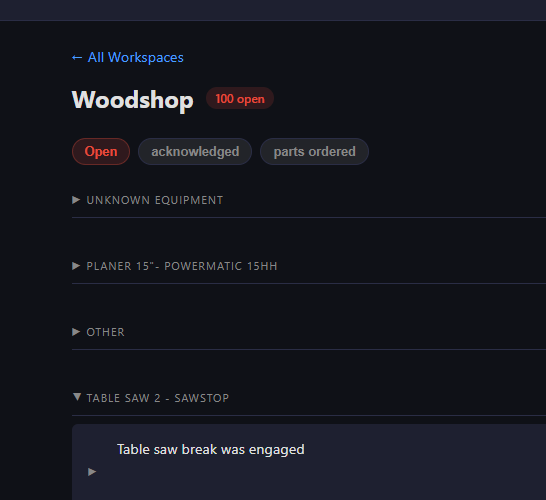
Woodshop receives most of the problem reports and the more reports means the harder it is to keep up with them and properly close them. The topic of Machine Uptime and Visibility is a big one and a bit of a challenge here. Certainly not impossible, just haven’t had enough folks ready or able at one time to make a good effort on creating the positive change we need. Please keep the comments and curiosity coming!
Thanks to @Rolo the page I linked above is now working. You may need to hard refresh the page (shift+refresh) to get the latest data but it’s working, updated every 15 minutes.
You can bookmark direct links if you’re interested in a particular area like Asmbly Problem Reports
There’s a lot of duplicates! Or some issues that were caused by other issues.
And I’ll admit there may have been one or two that I wasn’t 100% sure on, but it had been three or more months without any other notice since so I opted for closing it.
Certainly could use a bit more stewardship from my own side to close things out that I work on. I like to think I’m fairly good about it but I know I missed a few of them. Just going back and looking at this.
We are looking for a second wood shop lead to help @Glory2God as well. This is a lot for one person to handle and especially for one volunteer. If anyone is interested in stepping up next to Michael, reach out to him or to me and we can talk some details.
Outside of that, it’s going to be hard to keep up with everything. This isn’t the first Purge of the past that I’ve done, but it’s also not my favorite way to Mark things as resolved. Like Aneel mentioned earlier, sometimes things just happen and folks don’t even realize there’s a problem report open. This discussion hopefully is bringing some visibility to this page.
For folks without slack access and not wanting to go the whole volunteer route, please post updates and discourse and if folks have access to Slack make sure things get closed out.
Thanks very much for your purge of the past. It’s unfortunately necessary from time to time. Perhaps it should even be scheduled bimonthly or quarterly.
One thing that occurs to me is that there may be too many software tools handling the tickets, and not talking to each other. Solutions may include improving/adding interfaces or reducing the number of software tools that allow ticket creation and updates. There should be “one source of truth.”
Also it as problematic that one can red/yellow tag a tool without creating a ticket. It would be great to find a solution to that.
I would love to see some digital signage in each shop showing both general info for all members and info specific to the respective shop. That info could include the current per-tool view of tickets, rotating through.
In theory I agree with you. There are too many ways of viewing, tracking, acting on things. Practice though I’m not sure how to avoid it. I’m open to ideas!
In practice:
Staff, and volunteers have access to Slack.
Everyone has access to discourse.
Everyone is able to log a problem report.
The reports are useful so we can see what’s happening. But not everyone is able to tackle each report as they come in. We have a couple of folks that would rather not be on slack. However have been tremendous help in fixing things or troubleshooting things without being asked. The latter point makes paperwork and tracking a little harder, but I want to lean towards that if it means removing a barrier for someone to fix a tool.
Do you have something in mind for what you think might be useful for in shop signage (paper or digital) ?
In the 3DP space (which I acknowledge has FAR fewer machines, and far fewer problem reports than the woodshop), there have been two keys to keeping the count under control:
The shop lead reviews every PR soon after it is filed. For me, this means I get a notification every time a PR is filed (this is a Slack notification on the “3D” keyword in the #problem-reports channel). I am terminally online, and try to look at any new PRs at least daily. This helps me figure out whether a PR merits actually Red Tagging a machine. But if Slack pinging you is too annoying, other ways of making sure this happens on a regular cadence would work just as well, for example taking a look at a dashboard as linked above.
We try to handle any open problem reports on a regular cadence. For 3D Printing this is at our monthly Volunteer days. Most of the time a volunteer addresses any serious problem before the volunteer days, but this is an opportunity for us to address lingering non-red-tag-worthy problems. For example @klgilbert has been working on the filament sensors on our MK3S+ printers. It’s a quality-of-life issue, not something that stops you from using the printers, so it’s easy to put it on the back burner, but then problems build up into an intractable backlog.
This isn’t a “technical” solution, though good technical tracking systems do help us keep organized. It’s volunteers staying on top of things.
The best way to make sure that PRs get addressed? Volunteer!
Even if you don’t feel qualified to work on the machines, people will generally be overjoyed to bring you up to speed. We’ve had a lot of people show up to 3D Printing Volunteer Days having never touched a 3D Printer before and having never run a print, and they’ve left having done maintenance on a printer and learned at least the basics of how they function.
Maybe the one of the recurring woodshop workday items could be having someone review and clear problem reports. As part of that review, it could help determine if there is some higher priority thing that needs to be addressed before, or in addition to, performing regular maintenance.
That could at least help the upkeep if there isn’t bandwidth to continuously review the problem reports.
So we have Slack, Discourse, and ClickUp handling tickets/problem reports. It seems we need to do some “application rationalization” of the IT involved—map the apps and their data flows, understand the differences in reasons and roles for each app.
Then determine if/what changes may be appropriate to get to a “single source of truth.”
@Glory2God I think Al makes a great point. I know you pull up the maintenance list (separate from problem reports). If hands are available someone helping with problem report “maintenance” is a good thing too.
We have a few folks as our “IT Crowd”… nobody else calls it that, just me right now.
I don’t know when this month’s IT volunteer day is coming up, however this would be a great time and place to dive deep into this subject. Discourse is also a great place too.
I already do this as a part of not only the mini workday, but also as part of my daily duties.
Many of the PR are not related to equipment problems, but other types of issues such as cleaning problems, supplies, etc. so its an ongoing balance. One area that needs improvement is assigning tasks to others and them reporting back on repairs. There are some things that require either and/or both a greater time commitment and technical skills that myself or some volunteers have.
Aneel, I’m sure there is a lot of truth in that. I think a lot of folks are focused on their projects and their use of the tools and may not be thinking about ticketing. How could we build awareness beyond the initial orientation?