Help Us Bring a MOPA Fiber Laser to Asmbly! 🔥

Hey Makers!

Got some exciting news in Laserland!! We’ve been working on outreach to laser manufacturers on behalf of Asmbly, and one has offered to donate a 60W JPT MOPA fiber laser to the space.

If you haven’t used a fiber MOPA before, the short version is: it marks and engraves on stuff our CO2 lasers can’t. Metals (stainless, aluminum, titanium), plastics, stone, ceramics, and it can even do color-marking on certain metals:

What we need from the y’all: The machine is almost entirely being donated (going for $1400 new to have in our makerspace instead of a tag of about $7,000), but we still need about $2,000 to cover the fees for receiving it and to build a proper safety enclosure.

Fiber lasers put out light that’s invisible and especially dangerous to eyes, so a solid enclosure with safety interlocks has to be in place before anyone touches it.

Donate here!

Stretch goals: If we blow past $2k, we’ll put it to a vote among donors on what to grab next:

  • Rotary fixture for tumblers, rings, cylinders, round stock

  • Motorized extended work bed for bigger workpieces and batch runs

TLDR: This machine would open up a whole category of projects that just aren’t possible with what we have right now. If you’ve got questions about what a fiber MOPA can do, Reach out to lasers@asmbly.org!

10 Likes

What are the cutting bed dimensions? Can it do precise cuts on thin 4-6mil stainless sheets? I’m thinking solder paste stencils, I’m probably not alone.

1 Like

I recently cut some kind of stencil for someone with a tungsten foil. The holes were .5mm. I was easily able to cut it. I assume you should be able to do the same.

1 Like

Don’t quote me on this, but it should be able to get through 5mm stainless. That’s approaching its maximum however. May be better suited somewhere around 2mm.

Default working area is 150x150mm. With extra lenses that can go up to 300x300mm. With a motorized bed that can go up to 300x1000mm.

1 Like

I know next to nothing about lasers— could we cut stainless steel ribs with this laser?

2 Likes

Yessir!

1 Like

The laser has been purchased!! Thank you Nick for the discovery and findings for this, and a huge thank you to all of the folks who have donated funds already. There’s still room to donate for some of the extras Nick mentioned (extra lenses and motorized bed).

The laser will likely be on-site within the net 4-6 weeks. We’ll be moving quick as we can to get it up safely (with an enclosure) so we can open it up for members!

6 Likes

Do we have cad for the enclosure? If it sheet metal. I can cut it

My plan was 80/20 extrusion and composite aluminum panels, but honesty I’m all ears and very open to help/suggestion there as well.

The plan for the motorized bed does make it a more “fun” build than we’d normally need, since we’ll need 800mm of enclosed space on either side.

I think I have some dibond. Let me look

Sorry I don’t large pieces of dibond

No worries, allied next door has it for cheap.

1 Like

The MOPA’s galvo system is not really designed for cutting. Their niche is marking stuff and making detailed 3D engravings.

Realistically, it’s limited to about 0.5mm, and can’t be very wide since the galvo beam will vector off at an angle. All galvo types have similar limitations.

Trying to just do a cut anywhere on the bed without really extreme measures- just a simple cut- “foil”.
The most common lens we default to is the F160 110mmx110mm. The lenses go as small as 50x50 to 300x300.
The focal spot size scales with the focal length and working area. So, while a 300x300 lens is available, the focal spot dia increases by 2.72x and thus the energy drops to 13.4% of the starting point. The beam’s vector angle gets better when the lens has a longer focal length.

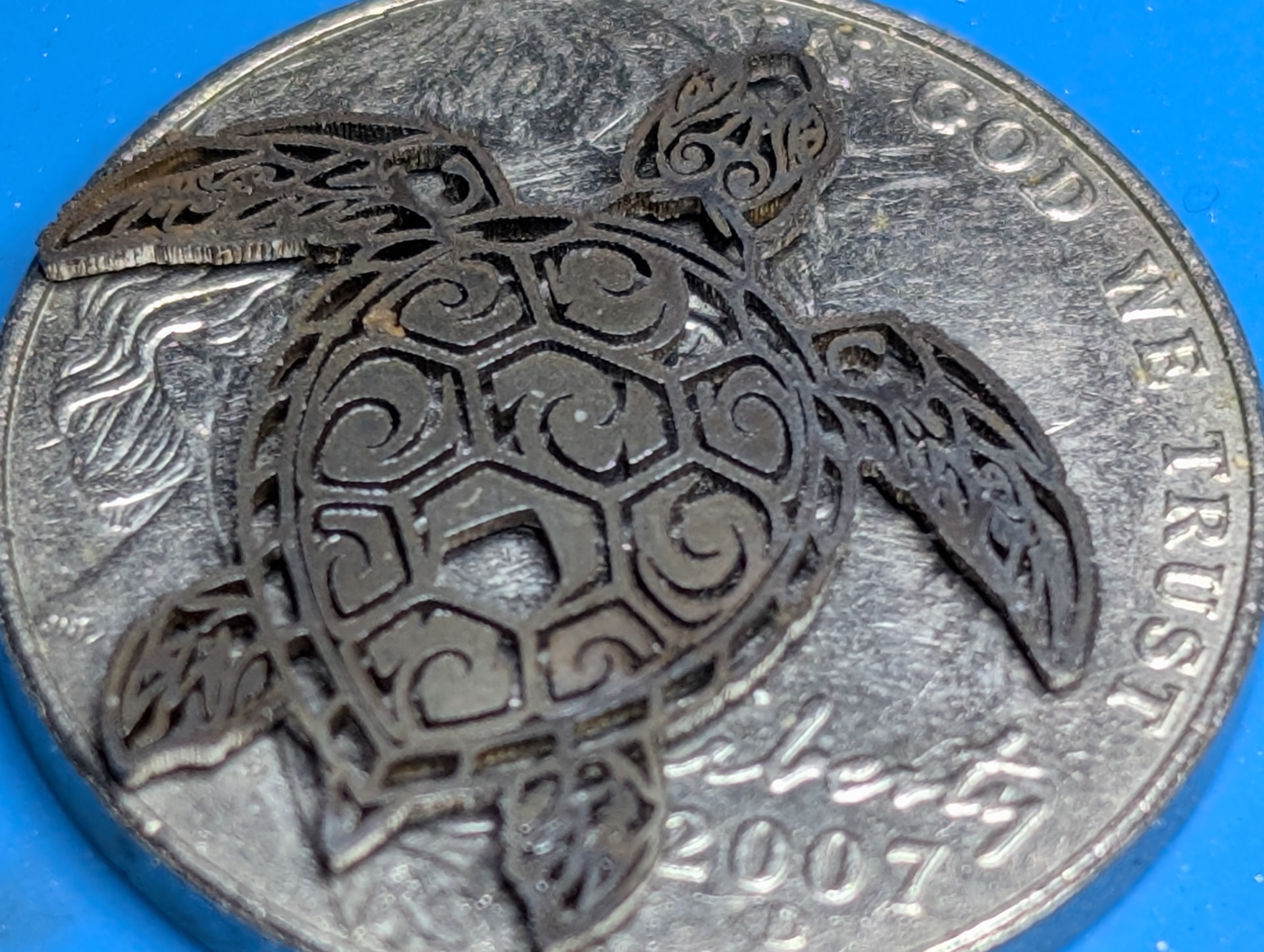
These were done on a 300W MOPA in a tempered steel utility knife blade. I came up with some calibrations and techniques and learned the unique dynamics of the MOPA in and out. Cuts of this type are not the norm. In fact they may be unprecedented, I thought it was just a quality attempt to show off and put it online and it seems like no one had been able to do something like this before. I brought in some specific fixtures and a powerful air assist setup that was a total game-changer and seems obvious it should be part of any bench- but I’m not seeing where anyone else has actually been doing it.

One of the points that may be difficult to get is that the material thickness isn’t the issue specifically. It’s how far off center a cut is, and how wide and sloped you think is acceptable- and going off-center will get super weird in how you would have to handle it in CAD- Lightburn has no features that make it easier. None of this is readily explainable in text, it would take diagrams.

Someone is probably wondering how you could say it can’t cut over 0.5mm deep if you can make a detailed 3D engraving 1mm deep (or more, sometimes). Excellent question. It has to do with the galvo and light cone geometry. Engraving features in the middle of the bed avoids problems that would foil attempts to do “normal” narrow cuts off-center.

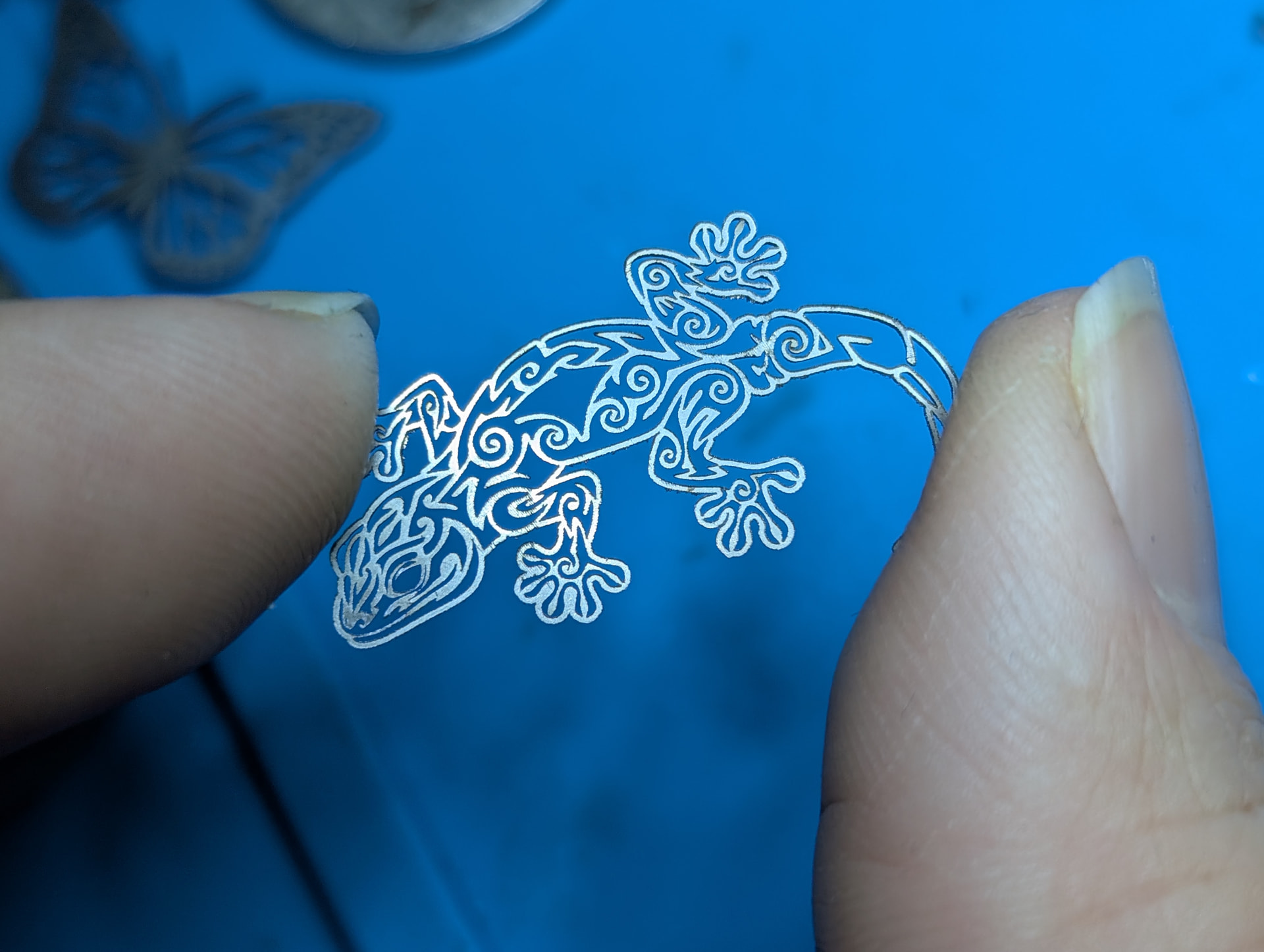
Actually there were parts of these that fell out, not because the cut went too far, but because I didn’t realize the design had inner parts with no support. I fixed that and went on to do some even finer detail intact. I need updated pics- I keep losing the darn things, they’re only a few mm across.

What’s with the motorized bed concept? I can see some cases where it could be helpful, but what I was thinking of would apply to some really specific use cases and wouldn’t be practical to set up here so we’re probably thinking of two different things.

The one thing I really came to understand is these can’t be exhausted outdoors through a long run like you would a CO2 laser. And definitely never pulled upwards.

The MOPA is uniquely problematic in that each pulse explodes off bits of metal dust on a wide range of sizes and properties. But they remain metal, and are orders of magnitude denser than CO2 smoke or CNC wood dust. They will not entrain consistently, and fall into a horizontal duct, and it’s worse on a vertical duct. It may seem to work at first but that’s deceptive and dangerous as different use cases can product unliftable particles that build up in the duct.

One, the metal particles could be highly reactive. There’s no telling if it will always be in an oxidized state- and iron oxide powder mixed with aluminum powder is literally thermite. Being such a fine particle size can make something more active than normal thermite, too.

The other is just how much of an occupational hazard this can be. It is reasonable to think of welding stainless and cutting on a fiber laser and it’s a concern there but we know how to handle that. But MOPA has a key difference- due to the way it cuts by making tiny explosions at a high repetition rate, it produces a fantastic amount of extremely fine nanoparticles that welding, grinding, and fiber laser cutting do not. This particle size is infamously capable of getting all the way into the alveoli of the lungs where they mucus can’t clear it out and it doesn’t cause a coughing reflex, and can absorb straight into the bloodstream.

Stainless produces particles of nickel and chromium which have a lot of hazard potential.
Looking at the gamut of what people might try, what came to mind is beryllium copper, used to make electrical contacts and some uncommon products. Beryllium is carcinogenic- like very carcinogenic, in minute trace amounts that make asbestos look like cotton candy- but only if inhaled, which doesn’t really happen in normal machining. But the MOPA isn’t normal in the way it processes- it turns stuff into powder- and the consequences of contamination with something that toxic can’t be addressed by just cleaning it up. And while lead testing strips are common, there’s no test to know if beryllium dust is present.

And I don’t have a solid answer there- but I do think a vertical lift exhaust should be off the table. These are commonly set up with the 150W Vevor fume filter. I thought it would be dicey TBH, but after using one for many hrs, I was impressed how well suited it was for the task, in ways I didn’t see at first.

Oh, I never covered this- before I got a good config on the air assist and filter, I was trying engraving on cupronickel alloy. Just small bits and nothing seemed wrong with the air at the time. But my lungs got pretty choked up the next morning- multiple times that indisputably correlated to using the MOPA without a solid exhaust filter. And coughing is actually my least concern- I can get over that and move on. But nickel and chromium (I don’t want to even think about beryllium again) can cause irreversible sensitization and even be carcinogenic. So, yeah, this has really become apparent to be uniquely hazardous but no one is even talking about it.

Also, another bad sign- the intake vents for the fans got brown smears all over them, and I had them beside the bench and the inlets were on the wrong side of the airstream to get contaminated. But they still did, indicating large amounts of ultra-fine dust were wafting everywhere. Thus prompting me to take this way more seriously than I did initially.

And don’t bother trying to get fiber-rated safety glass. It’s expensive, too small, and kind of pointless because it tints the light heavily towards orange or green. So you can’t use it to see what colors you’re getting, and you can’t see the color showing metal is overheating. It defeats a lot of what you want a window for.

The original plans were for 3M Crystalline nano window tint. It’s not marketed as laser safety tint, but its specs appear outstanding for the task, and these performance assumptions can be physically checked before signing off on it.

https://multimedia.3m.com/mws/media/1919596O/3m-automotive-window-film-crystalline-series-tds-re.pdf

95%-99% block of IR (it specs 900nm-1000nm, but 1064nm is close enough that it should be the same), 99.9% block of UV. Neutral tinting with 72%-17% light transmission. With bright full spectrum illumination inside you can see everything you’re doing in its real color. You can build as big a window as you want and the film is cheap. Also, I think tinting both faces of a window is an option.

The cut outs look pretty cool! Very nice close up perspective, thank you for sharing.

Making sure I am following right, sounds like you’ve had much better experience with this as an engraving tool. Seems like it could cut, but maybe not as precise as you’d like out of the box.

Ventilation is a great topic to bring up. Given we’re trying to be better about this with every new addition, this is no exception. If people are using this and coughing the next day, we’re not setting them up right.

It’s not about precision, or even power.
It’s about the geometry of all galvo laser systems.

The beam is always taking a path from the mirrors (the focal length of the lens plus about 40mm or so) and is 10mm wide at the mirrors. It will be about 15 deg from vertical at the edge of the workspace for any lens.

The true focal point has a 1/e2 dia of somewhere around 0.025mm-0.040mm down the centerline on an F160 lens with a 10mm galvo aperture. The dia is about 50% higher at the edge of the workspace, so best energy density is only 44% of workspace center. 1/e2 is a figure for where the laser energy drops below 13.5% of the intensity in the center and 86.5% of the beam’s energy falls inside the 1/e2 circle. It’s gaussian distribution, a “Bell Curve”, of energy density vs radial distance from the center.

That’s the overall energy distribution at the focal point. The actual spot size of the mark varies. It may be that only a 0.01mm dia circle has enough energy density to affect the metal surface so the mark is 0.01mm dia. It’s also possible that a really powerful pulse could penetrate deeply and create subsurface expansion that explodes off a crater of metal larger than the focal spot.

For a 110mmx110mm workspace lens, the beam dia increases by 0.0625mm for every mm past the ideal focal point along the lens axis. The neat magic of the F-theta galvo lens is that the focal point is not a constant distance from the lens, that would have made a focal plane into a hemisphere of about 200mm radius. But F-theta design means an F160 lens has a focal point 160mm from the lens’ virtual focal plane only when going straight down. It is longer focal length at nonzero angles (theta) that matches the hypotenuse so it creates a flat focal plane to work on.

At the center of the workspace, the focal energy density drops to 50% when you move 0.66mm below the focal point. The edge of the workspace, 55mm from the center, the beam is slanted about 15 deg from vertical, and the energy density drops by half at about 1.5mm from the focal plane.

The thing to see is that the beam energy is a converging/diverging cone, 10mm dia at the mirrors and near zero at the focus, but it also slants as high as 15 deg to reach the edge.

It can cut at the surface easily enough, about 0.05mm deep, perfectly. But then the energy cone of the beam needs to have a clear path carved out for it to reach the bottom of the cut. The geometry of what you’d have to carve out to make a path to the bottom of 1mm thick material is totally different at the edge of the workspace vs the center.

Additionally. the beam needs to be focused on the bottom of cut as that bottom moves. That can be done manually by just readjusting the Z focal height, but note that’s not the same as clearing the path for the beam to reach the cut bottom. In fact, when you lower the Z by 1mm, due to the slant of the beam, the point where the beam intersects the surface of the material will shift inward by 0.275mm at the edge of the workspace but none in the center.

Or, if you’re vectoring a line on the edge of the workspace, it will engrave a line about 0.035mm wide. If you do it 100x over, it will get slightly deeper and cut at a 15 deg slant but gets out of focus. Lowering the Z by even 0.064mm will shift the beam’s center point 0.035mm/2 towards the center. Now half the beam’s energy cone hits the surface outside the cut, and it’s somewhat out of focus there.

The galvo laser is fundamentally different than the CO2 or fiber laser cutting bed. To cut metal, the metal must be cold and then get hit with an extremely fast, dense energy pulse that explodes off a tiny particle of metal. If you keep drilling the same spot, the material will heat up and the surface starts to melt or at least become viscous and the same beam energy can’t explode a chip off liquid metal anymore. It will just deliver more heat and melt it but unlike a fiber laser cutter, there’s no air jet to blast a clear cut through this molten metal path. So all it does is melt, flow into the cut you’re trying to make, and actually close it off instead of deepening it.

So where the beam’s energy cone intersects metal outside the focal point, it doesn’t self-clear that path to reach the bottom. It just heats up the metal and it may even close the channel off.

Lightburn offers a “wobble” cut to try to get that depth cut by making a wider path. It is not a really comprehensive solution though- it’s able to get some depth out of a cut in the center, but much less so off-center, and it can make a problematic amount of heat. I’m not sure Lightburn really understands the problem, there actually is an algorithmic solution but it’s pretty weird.

@NickE When is this expected to be up and running/ usable? Do we need a class on it as well or is it just lightburn?

Hey Jesse!

Our current main blocker is the removal of Pearl. Until that’s done, we can’t get things set up in their proper location. I believe that will be done sometime in the next week or so, which will allow me to give a better projected timeline.

There will be a prerequisite class, as mopa galvo lasers have a number of functions within lightburn that are not present when using a gantry laser. I’ll keep you updated as we have a more concrete timeline!

2 Likes

Hey everyone!

Things are moving along in MOPAland :tada:

Initial tests are complete and the OMG-X arrived in great shape. Next up: building the Class 1 safety enclosure so we can get it in members’ hands safely. Construction kicks off this month!

A huge thank-you to all of our donors! Because of you - and the incredible generosity of OMG, who threw in a rotary attachment for FREE - we hit our fundraising goal. That covered the shipping and customs to get the laser here, plus all of the planned accessories. Our motorized workbed is on its way to us now!

A few quick highlights of what this machine will unlock for the community:

  • Permanent marks and deep engraving on bare metals (stainless, aluminum, brass, copper, titanium)

  • Color / anneal marking on stainless and titanium

  • Anodizing removal, paint/oxide stripping, and high-contrast plastic marking

  • Cylindrical work via the included chuck rotary, plus long/batched parts via the motorized workbed

Pearl is on its way out to make room for the new setup.

Full proposal attached for anyone who wants the details. Questions, ideas, or volunteer help on the enclosure build (We have a few folks helping already, but more hands makes easy work!) - drop them in this thread.

MOPA Laser Proposal.pdf (112.3 KB)

5 Likes