Does anybody know the shrinkage percentage of the clay that is sold at ASMBLY? I’m planning on slip-casting some pieces but need to know how much larger to 3D Print my mold positive to account for this shrinkage. Cheers
Supposedly Cinco blanco shrinks 11.7 % but I’d do a test. I think it’s more that that. Buffalo willow 13 % . I’m curious about your casting . Are you casting directly into your 3d print ? Or are you doing a plaster mold ?
1 Like
The clay we sell can’t be used for slipcasting.
Armadillo sells some Laguna slip, but we’d need to run a test of it before firing actual pieces.
Additionally, you can’t really use a 3d print as a mold for slip casting. It can be used as a master to create plaster molds, but the slip needs contact with plaster to dry properly.
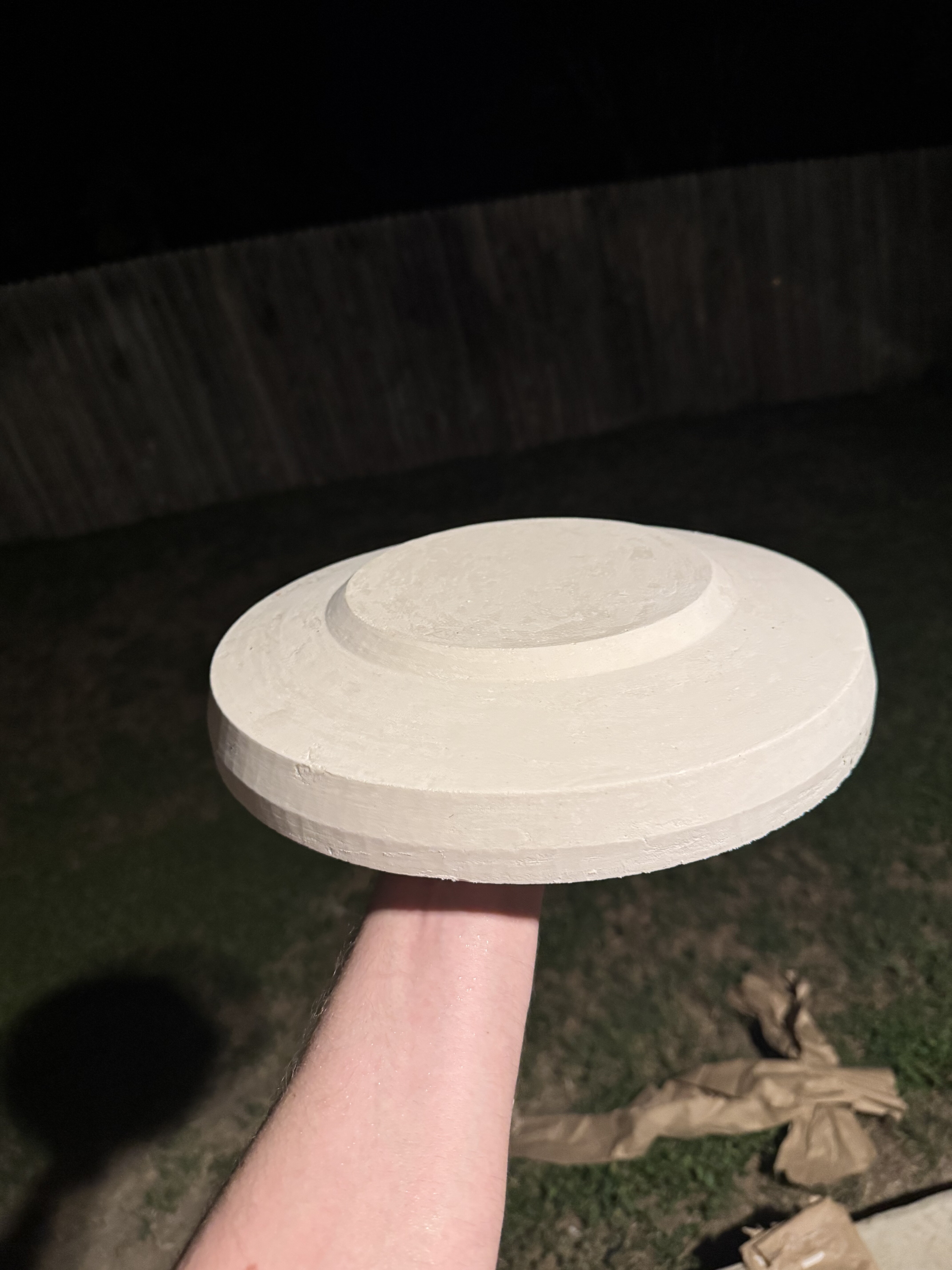
Funny timing, I just poured my first plaster bat into a 3d printed negative not 5 minutes ago.
Fingers crossed it goes well, it’ll allow me to throw plates repeatably on the wheel with little effort.
Edit: IT LIVES! Pretty much perfect.
2 Likes
Why are you saying we can’t use our clay for casting? We already fired pieces that used plaster molds.
I’ve seen videos of people using 3d molds directly but I’m curious about if it’s really something worth trying .
Nice plate BTW
Slip casting isn’t “casting”.
It requires that you use slip (deflocculated clay).
We don’t sell slip, and you must use plaster molds for slip casting.
You can do slip from clay
You cannot make slip for slipcasting (casting slip) without substantial modification to the clay body, at which point we’d need to fire test tiles of it.
This is not the same thing as “slip” made by adding water to normal clay.
I have done it with no issues. But ok. People have different methods . And ceramics it is a lot about experimenting.
Yes, and folks also use lead as a glaze flux without “issue”.
Like I said, it’s not impossible, but would require further testing as per the approved clay bodies with our currently policies. Adding other ingredients to a clay body makes it no longer that clay body (and is quite frankly is very hard to do correctly)
There’s a reason Armadillo sells a Laguna casting slip and doesn’t make one out of their own clay, I’ll let everyone draw their own conclusions as to why that is.
Yes I do know this about slipcasting molds- they must be made of pottery plaster. Do you know why the clay ASMBLY sells can’t be used as slip? I was under the impression that any clay could be made into slip. And how can I run a test, would I just get in touch with a kiln manager?
Technically, you could use any clay body to create slip for slipcasting. It’s just a very time intense process. Generally you would use clay trimmings/scraps and let them dry out to bone dry and then grind them up and rehydrate them. You’d probably have to add deflocculant and test it until you reached a specific gravity of 1.7ish. You’d probably want to sieve it as well.
There are also recipes for making slip out of dry ingredients. That would still be time consuming, but less so than turning scraps into slip. Andrew Martin has a book called The Essential Guide to Mold Making & Slip Casting that has recipes for slip for slipcasting as well as a lot of information on mold-making and general slipcasting information.
Armadillo sells a Cone 5 Porcelain, Cone 5 B Mix, and Cone 10 Bmix slip for slipcasting at like $20 per a gallon. I would start there to be honest before trying to make your own slip. But, it is totally possible.
3 Likes
Thanks for the thorough response! That process does seem like more grease than this elbow will take- at lease for this project. I’ll check out the Armadillo Porcelain you mentioned.
2 Likes
As an complete tangent, I was reading this thread and didn’t fully understand what defloculation was but was curious because the word sounds cool. I found this extremely detailed explanation and was thoroughly enthralled for the next 20 minutes or so. It’s amazing the depths of information that are freely available, and what can be learned when curiosity strikes: Deflocculation
I love the balance of science and art that ceramics strikes. A mixture of fluid dynamics, mechanical engineering, rheology, geology, thermodynamics, materials engineering, and I’m sure a lot more I’m missing, but then also an element of chaos and creativity required. My favorite type of hobby
3 Likes
tangent on a tangent  If you ever want to see a massive slipcasting operation, Kohler does factory tours: Tours | Activities & Events | Kohler, Wisconsin
4 Likes