I found the metal lathe’s catch basin significantly covered with steel swarf (cuttings/chips) this morning. It doesn’t appear that any attempt was made to clean the lathe at all.
Needless to say this is completely unacceptable from a cleaning standpoint.
I would in fact ask that people who are machining steel make an extra effort to clean the machine thoroughly afterwards. The aluminum swarf we recycle has been excessively contaminated with steel in the past. While this cannot be entirely avoided, making an extra effort to clear steel swarf would help.
However, this incident did make me aware of another problem.
This photo doesn’t really do justice to how much material was there or the colors of the material. But most of the material was a rather dark blue, which means that way too much heat was being generated while cutting it.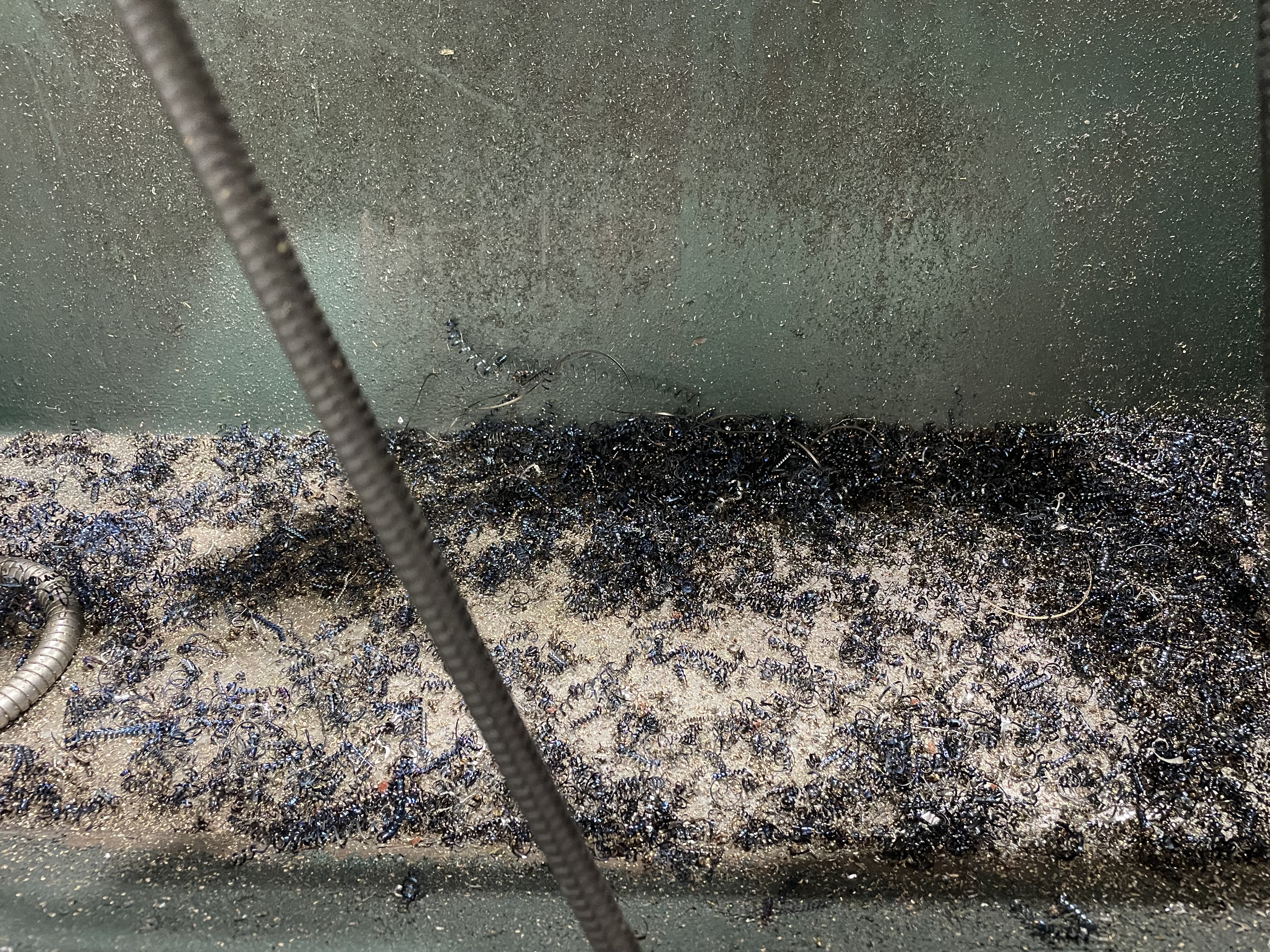
When you are machining steel, the chips you are generating should be the same grey color as the original metal. If the chips start to come off yellowed, that’s because excessive heat is rapidly oxidizing them. If the chips come off blue, you are essentially burning the steel.
While we don’t really care about the state of the chips, such heat causes other problems. Thermal expansion will hurt the accuracy of your pieces. But primarily, excessive heat causes rapid wear and dulling of your tools. This leads to a rapid downward spiral, as dull tools create even more heat when cutting.
You can destroy your own tools if you want, but on the lathe, Asmbly provides the inserts, as well as the parting bars. If you dull one of these, you’re leaving a problem for the next user of the machine.
How do you avoid generating this heat? First, never machine any type of steel without a cutting fluid. The lathe has a built in cutting fluid spraying and circulating system. If you are having flow problems with that, try filling the reservoir more fully by pouring pre-mixed cutting fluid into the drain in the trough. You might need to add several gallons. Keep a constant flow of fluid on the cutting point.
Other things that can cause excessive heat generation: too deep a cut, feeding too fast for the chosen machine speed, and a dull tool. For the latter, don’t hesitate to rotate or replace an insert. (We are somewhat short on the less common inserts right now; I’m working on that. And please be sure to use the right tool! Some bolts are hex/Allen and some are Torx.)
But if your steel chips are coming off blue, you should not continue cutting. Change something until that stops. Increasing the coolant flow is often the simplest option, but definitely examine the condition of your insert or tool too.
I’ve been teaching this in recent classes but had not addressed this in the past. I myself didn’t understand the issues here — I’m still learning as well. So I’m taking the opportunity to update everyone.
Summarizing: If you are generating blue steel chips, you are creating way too much heat, which is destroying the tools. And of course clean up after yourself, but please be more thorough in cleaning up after machining steel.