I’ve been trying to clean the leftover PETG off my the plates I used to print for the last hour and a half. I just can’t seem to get the last bits off. Unfortunately, I wasn’t there when they were removed from the printers at the time the print finished. I’ve tried heating and then cooling the plate in the freezer, and have tried every plastic scraper in the 3D printing room. Does anyone know any better strategies to clean these plates? I’m just killing my hands trying to finish the job here.
I’m really sorry, but I’m going to have to leave the building without fully cleaning them. I am happy to give it another shot tomorrow or whenever I come back, but I have to get going now.
Let me know if there’s anything else I should have tried.
I haven’t taken the 3D printing class, so forgive me if this is a stupid question. But is there a scraper with metal on the end, rather than just plastic? That’s what I use at home and it works great. That and isopropyl alcohol usually work for me.
Swap the plastic blade on one of the green ones. That’s what I printed them for, see: Please don’t scratch up our build plates. Be careful not to dig the corner of the blade into the build plate, as they can still gouge them.
IIRC we don’t allow metal scraper use on the filament printers, but I may be wrong.
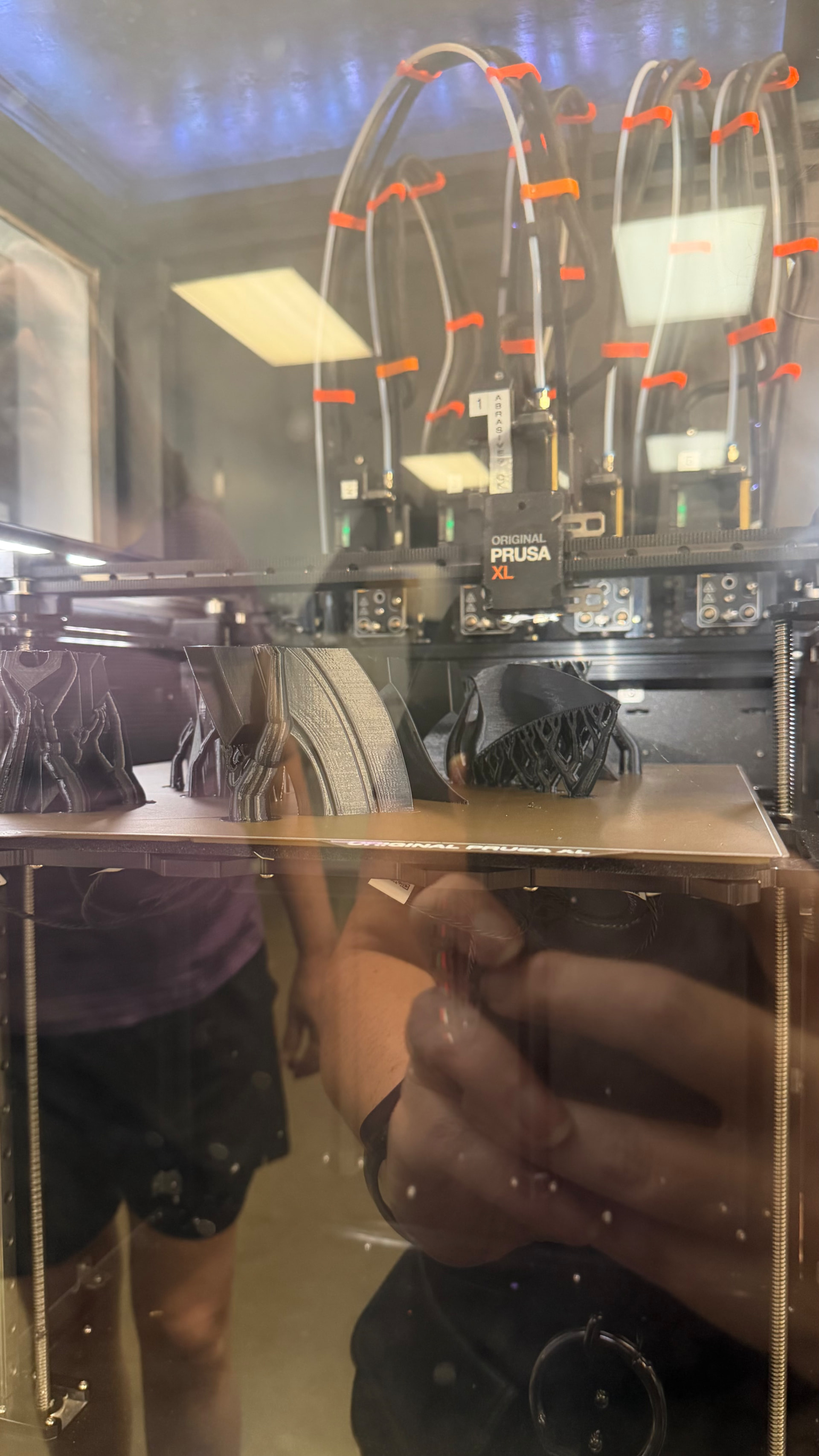
Oh no! Thanks so much for letting me know,@Julie. I thought if I loaded in 2 rolls, then the printer would automatically swap heads. That’s disappointing that it didn’t. Does anyone know how to resolve this? Is it correct to just reload the first head?
It’s possible the filament sensor is disabled on that print head. I’m not sure if you can set it up on the XL (haven’t looked), but I do think the bamboos can handle it.
The Bambus definitely can handle it, I’ve utilized that before. I looked it up online and it seems like its a configurable setting based on firmware? I can look more into it.
@Julie , is there any way that you’d be willing to reload head 1 with what’s left and resume the print? I am not sure if I can make it down to the makerspace tonight. I can definitely be there tomorrow to sort it out, but I’m worried if the print sits for too long, it will be hard to resume. No pressue if that’s not something your comfortable with!
Runout detection should be enabled in the xl - you can check this in the settings before you print.
Spool swap does work! But again, you have to set it up before the print. In the pre-print filament menu, if you try to map the color that already is set to another toolhead, you will get a prompt to replace or join. Pick join!
For petg on textured plates, I often have the same issue! As with most things, preventing is much easier. Here are some tips, though they don’t always work:
Satin sheet seems to peel better
Let the plate cool before attempting to peel. I don’t do this, I need it now!
Bend the plate downwards a bit in many directions before attempting to pull on the part.
Bend the plate a little bit with a plastic scraper as the lever - much thinner than your finger to get under a print.
Don’t use a brim with petg - single layers are the worst to get up
If a particular petg is known to stick too much, a clean build plate doesn’t help. Touch it! (Just clean it afterwards for the next person )
That said, removal can be a real pain. The plastic blades are pretty good. Don’t use metal, as said before. If there’s a small area still stuck, the best answer I’ve found is… More petg! Print something small on top of that area and it should take the old petg up with the new.

 )
)