I’m looking to hire an experienced Asmbly member to help fabricate a 12″, 2″-thick live-oak “record” on Tarkin or Dorian.
Scope:
Fixture/jig to support & level a heavy round slab
Dial in LightBurn workflow (test swatches → final pass)
Clean, shallow concentric grooves with minimal char
If you’re talking about ”record” as in old vinyl analog audio then being able to find the center of your stock will be important. In the event you’re not familiar with it, in LightBurn’s “Laser Tools” menu there’s an option called “Center Finder”. It works remarkably well and should simplify your process.
I don’t think my post was very clear - I’m hoping to burn an audio file into a wood “cookie”. I have no experience with laser fabrication, so I’m looking for someone to help navigate using the Tarkin. I believe I have the code generated.
oh amazing, sure! Happy to pay you for your time too. Unfamiliar with this platform and how to roll this over to messages… want to shoot me an email and we can work out details? steven.c.parker@gmail.com
It’s mentioned in the thread James linked above. That being said, I can do this for you on our lasers if you don’t have the time for that. I’ll shoot you a quick email (there may be some limitations using live oak).
So you want to encode aural data into it? I wouldn’t know how to do that. I was just thinking about carving concentric circles (or a long spiral) into the wood.
The Audio-to-Groove G-code Generator is a Python program that transforms a stereo MP3 audio file into a continuous spiral toolpath resembling the groove of a vinyl record. It reads the left and right audio channels, computes their combined (vertical) and differential (lateral) signals using the 45/45 stereo encoding standard, and maps these modulations onto a spiral defined by user-controlled parameters such as outer and inner radius, spiral pitch, and amplitude scaling. The program outputs standard CNC G-code commands that guide a V-bit or engraving tool to carve a shallow, audio-encoded groove into a flat surface—ideal for wood, acrylic, or metal. When executed on a CNC machine, the result is a visually striking spiral pattern whose fine undulations mirror the original sound waveform, creating a decorative and conceptually faithful representation of the music as a physical, record-like groove.
yes, I have already generated code both for laser & CNC that translates the audio to a vector / .nc file. But sounds like CNC might be a better choice than laser since the different parts of hardwood respond differently to laser vs CNC which provides absolute depth?
How are the CNC routers at the makerspace – do they provide enough precision for something like this? I think it needs to be a pretty small bit.
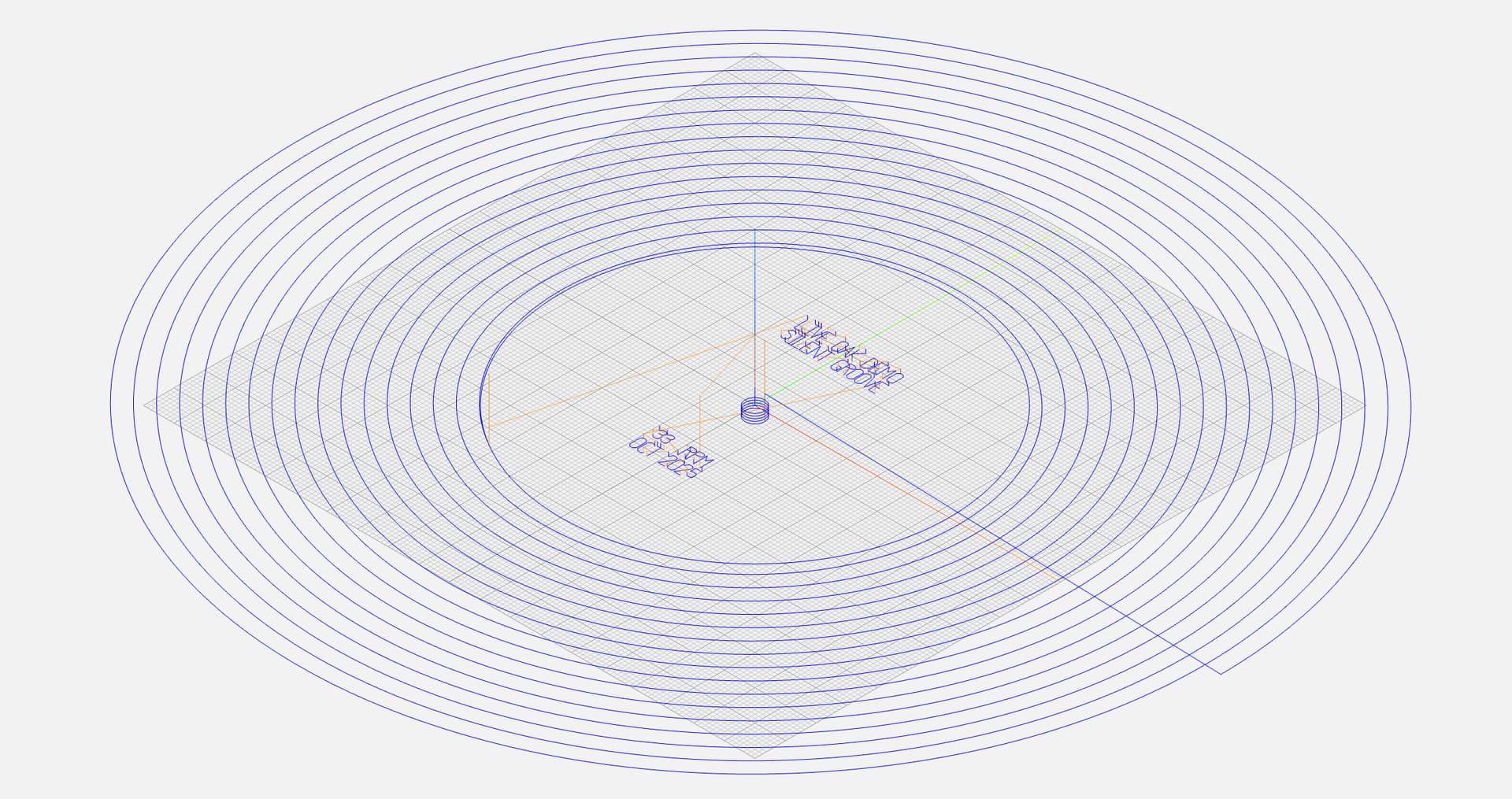
Here is a ncviewer output of the CNC path I’ve generated through my approach. The track-to-track pitch is 5.33 mm and overall the record only represents 30 seconds of audio. But I thought it was good enough to show you. And then I added a spindle hole and some labeling. The assumption for the below is 1/4” 90 degree v-bit end mill. So how accurate need it be and do you intend to play it somehow?
Yes, the goal is to have it play a 12" wood “cookie” record. I’m going to modify an old record player, adding a motor with more torque and building a needle from a toothpick and a contact mic.
Is it best to use stl files with the routers at Assembly?
Define a simple test cut on cheap wood to try out the technology. How much audio do you need to encode on your record in seconds or minutes? Instead of a toothpick because it’ll break too easily, consider metal stylus or a light-source probe of some sort (this is far outside my skill set)
 If you’d like to try it out, to see what it would look like, let me know.