I needed a new vac at home, and Black Friday’ed this one. The Dysons are assumed to be a “gold standard” but they’re overpriced and I suspect are actually not as powerful as the newer gen of Chinese vacs.
The Levoit LVAC300 has a ton of top reviews online as the best. But it could be seller-driven engagement for reviews. I just paid $220 on Black Friday and am hella annoyed that Amazon DROPPED the price to $200 AFTER the “sale”. Fake sale.
There are ones as low as $130 for “600W 60kpa” specs, and a similar layout. Might be the same tech for less, I can’t be sure.
To be clear, this is my LVAC300, I’m not leaving it here. I wanted to know if it could be better at removing laser pieces off the honeycomb without that PITA cord that can only be plugged into that one outlet on the wrong side of the room.
I’ve use a much smaller, cheaper Chinese hand vac for this, it actually worked “ok”, a bit limited on what it could pick up and pass through and hold but still better than the corded vac.
The LVAC300 is deceptively quiet- it sounds like it’s gonna be weaksauce, but it’s quiet because the fan is producing suction very efficiently. It’s not quite as strong as the small shop vac, but close, and more than enough to pick up any piece that a vac could handle. It is BETTER at removing debris because it’s not jamming pieces in the hose. Did these tests at top speed which reduces battery life, but it was WAY better than the corded vac.
First test, noted that the larger bits make it through but got hung up in the “cyclone” area in back of the bin. If you’re not vacuuming up dust, do you even need that? Actually, you don’t. There’s still a filter past that which will keep debris out of the fan, but it would clog up quickly if you drew dust without the cyclone and screen. But that’s not our use case, lasers have no dust.
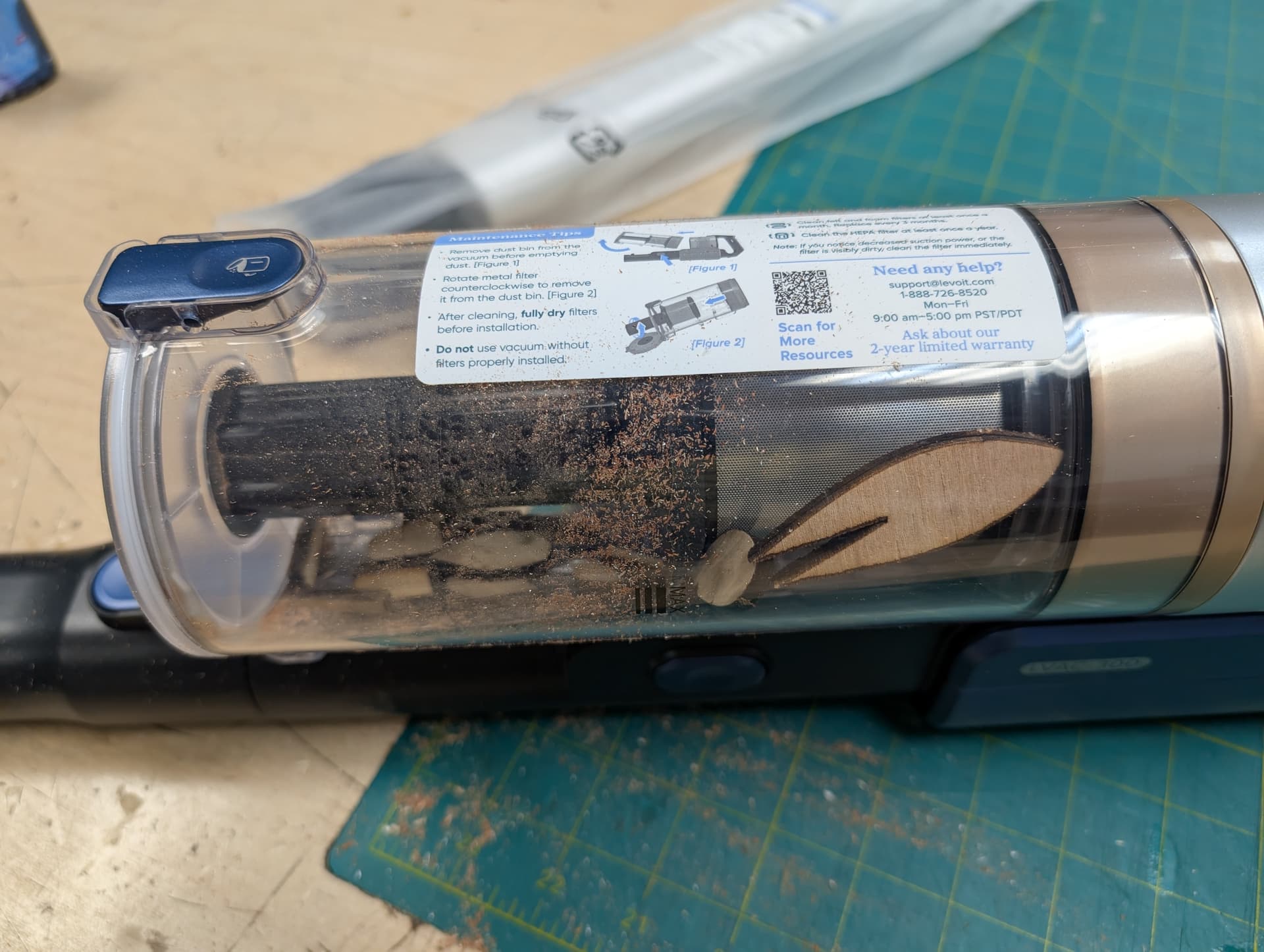
Can you just remove it for laser debris? Actually yes, and it worked quite well! There’s dust inside the bin, because I already took it around the shop and picked up dust elsewhere. High triboelectric static charge on it and that stuff clings. That piece is a sort of cyclone with a metal mesh coarse filter. It has a restriction to create a high velocity cyclone that flings heavier stuff past the screen, but it’s not meant for debris quite this big even though the passages let it come in. I could see 3d printing a different one that still has the coarse mesh filter and some cyclonic action, but enough room to fling the largest things that could get through the passage inside.
That may make it a laser-room-only tool, or maybe the 3D print will still work well on dust. Either one is a win.
Hmm, is it enough for general spot cleaning around the shop? I’d say so, certainly. This is 10x easier than hauling out a corded cart. I’m certain people will clean more if it’s this easy. It’s a little less raw vac but not by much, and the accessories direct the suction pretty well.
The attachments on this one are SMART. The brushed spot tool weirdly seemed to be fused with the crevice tool base. Turns out they’re the same accessory- the brush rides down a track, captive, and locks on the tip of the crevice tool if you need the brush.
Downsides-
Limited battery life- on “turbo”, spec is 12 min. TBH, nobody will use it for more than 12 min at once. It’s for spot cleaning. You need like 30 sec to vac the tracks of a table saw or handle the crevices of the jointer, crevice where a tool bottom reaches the floor, or clean a small mess.
Limited capacity- probably enough for a ton of little drops on a big Tarkin job. I could see filling it maybe, but it’s easy to dump and keep going. That would be a LOT of woodshop dust or jointer chips, you might run out of battery capacity before filling the bin once.
Not that durable- I can foresee one of these being dropped sooner or later, and that clear acrylic bin will crack on a corner drop. But it’s not that expensive to replace if that’s a rare problem.
I took a look and thought about this- I can see where I could 3d print some oversize PLA or TPU bumpers to attach to the clear bin end without interfering with emptying, not block the handgrip, buttons, or exhaust vents. It’s pretty small overall, and not that heavy so easy to protect. Almost all the fall damage risk is on edges that can be bumpered, making it an armored war machine. But I’d rather do that for a mainstream name like the LVAC300 where people will reuse the STLs, instead of one of the no-names.
Only has a small hook as a wall mount, and a barrel jack plug. The small wall hook (like 2” wide 1” tall), I can see people overlooking that when looking to put it away and just leaving it on a bench. I want a big chonky Playskool self-aligning holster thing on a wall or cabinet side you just drop the vac into, the only way it can go, without figuring out how that “works”. Clumsy-friendly. 3D printed in the same bold color screaming “this is where that thing goes!” from across the room.
Thought more- half the time, they won’t fiddle with a barrel jack and it’s not going to be charged. That’s just a wall wart- low voltage, moderate current. No design yet, but I can see making an extension for the barrel jack to electrical blades that will be sure to connect when you drop it into holster. I have spare spring blades that they use for DeWalt battery drop-in chargers. That would work, but it’s only 900mA 24v, it would work with almost anything metal too. That will surely have an internal diode so you wouldn’t need to add features to prevent contact with the vac’s blades- no current would flow if you shorted them.
I’m gonna measure mine and 3D CAD up some ideas for drop protection bumpers, and a wall holster with drop-in charging contacts. I kind of obsessively 3D CAD and print new solutions that usually end up working really well, I like a challenge.
It would help to have an accurate 3D scan of it first. Or caliper out as much as we can. The thing is, the curves around the handle base are difficult to match and would do better as a scanned 3D point cloud. It’s important because the closer that fits, the stronger it will be and the profile’s extents can be reduced. Caliper dimensions will help more with the overall wall holster profile and work out how it drops onto it.