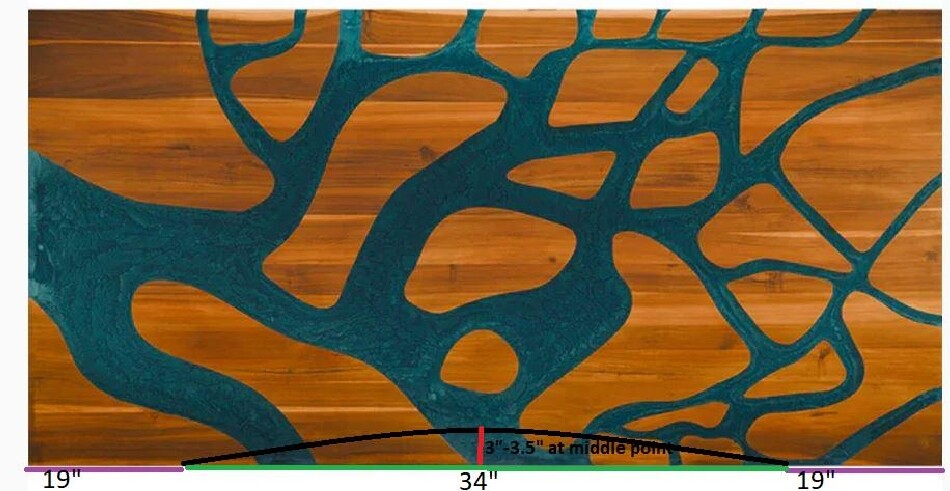
I’m doing a project where I need to cut out a semi-circle shape from an acacia table (with resin epoxy design) to create space for me to move closer to my office desk. To accomplish this, I’m thinking of making a template using an MDF sheet. I’ll cut the shape out of the sheet using either laser or CNC (which would be better?). Then I’ll use clamps to mount the guide to the table. Then I’ll cut out the semi-circle shape from the table using a jigsaw following the guide. Then I’ll use a pattern bit on a plunge router to get it perfectly round. Then I want to create a chamfered edge (I assume this requires another separate bit?). Then I’ll sand it down with one of those small power sanders (and eventually apply a new oil finish).
The table is 72” x 38” x 1.5” and the semi circle will be 34” x 3.5”.
Does my plan make sense overall?
Does anyone have spare MDF I could use for this project? Happy to pay
Would anyone be able to help run laser or CNC for this if I provide a DXF/SVG/etc. file?
Would it be preferable to use laser or CNC in this case?
How would I create chamfered edge to make it perfectly round? I have no experience with this
What kind of pattern bit should I purchase to accomplish this? My budget for the bit is $50.
One potential problem is that the table has live edges. Does that pose any risk to this plan?
This is one of my first big woodworking projects for context so I’m in the process of learning a lot of things right now . Appreciate any help or advice. If anyone would be able to guide me through the execution too that’d be awesome but I know that’s a lot to ask for haha. I’m looking to get this done anytime in the next 2-2.5 weeks but very flexible on time. Thank you!
While direct from the CNC as Frank suggests would work, you’d have to get the alignment of the table on the bed exactly right, and since this is a modification of an existing table, you’d only have one chance to get it right. If you cut a template as you propose, you can be certain it is aligned how you want before you cut any of the existing table. That might be worth the extra steps.
If you are using MDF for the template, I would use the CNC routers. I don’t believe the lasers work as well on MDF as they do on plywood.
There are round-over bits for making smooth rounded edges. That’s actually the bit I use when teaching about the router in the Woodshop Safety class. If you want to match an existing round-over, you’ll have to be certain of it’s radius.
For the pattern cutting, I think in this case either type of pattern bit, top bearing or bottom bearing, would work. (One of these is often called a flush trim bit.) Ideally the cutting length will be greater than the thickness of the table. (It might be possible to do this in multiple steps, but it’s a lot more trouble.)
Make sure your router cuts aren’t too deep, and be certain to pay attention to the cutting direction – always have the direction of the bit’s cutting oppose the bit motion. The opposite, called a climb cut, is never controllable on a manual router. These caveats are true for any manual router, but apply even more if you are using Asmbly’s trim router. It’s a great router, but it’s small mass compared to its high torque can make it hard to control safely sometimes.

 . Appreciate any help or advice. If anyone would be able to guide me through the execution too that’d be awesome but I know that’s a lot to ask for haha. I’m looking to get this done anytime in the next 2-2.5 weeks but very flexible on time. Thank you!