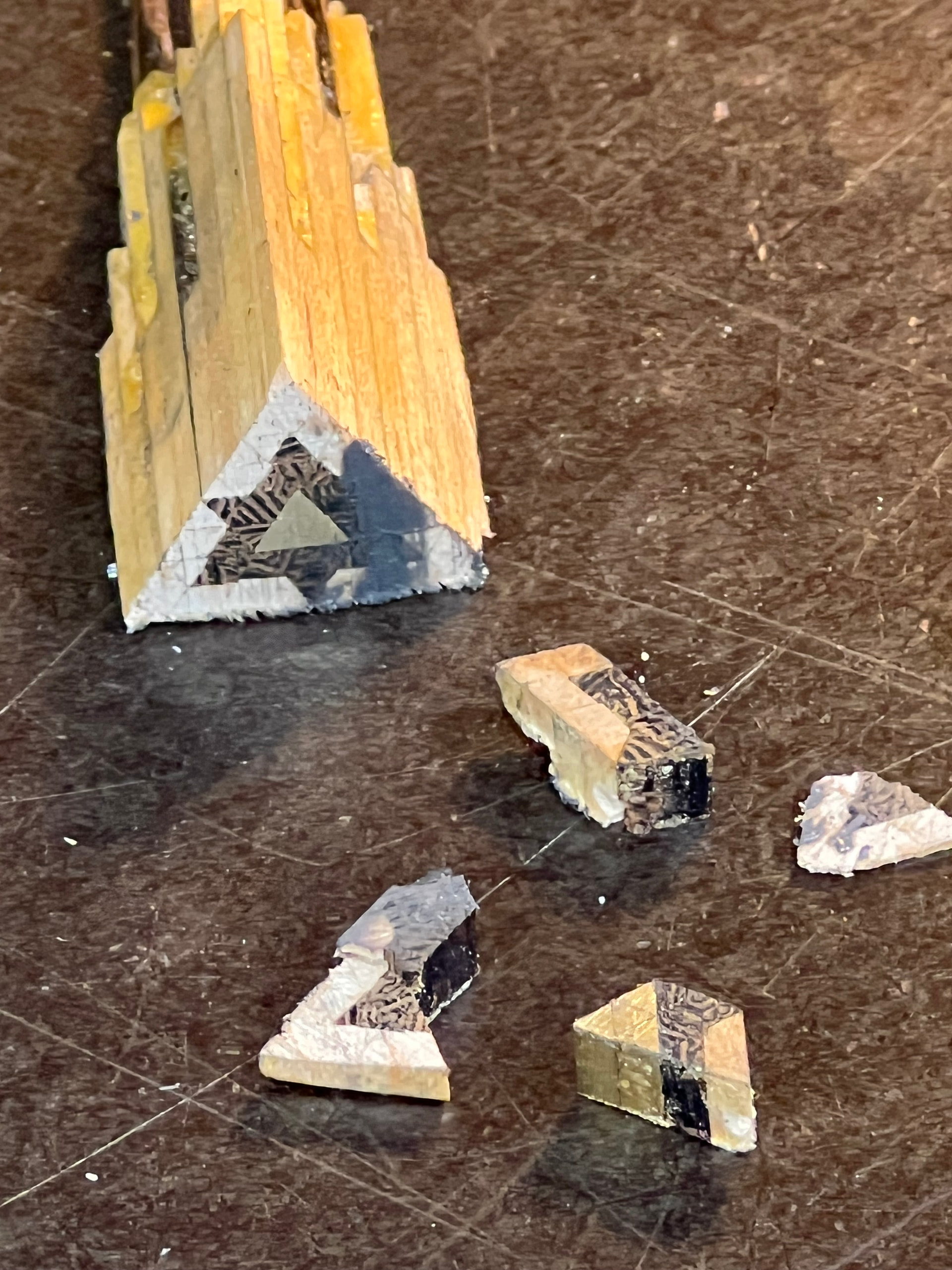
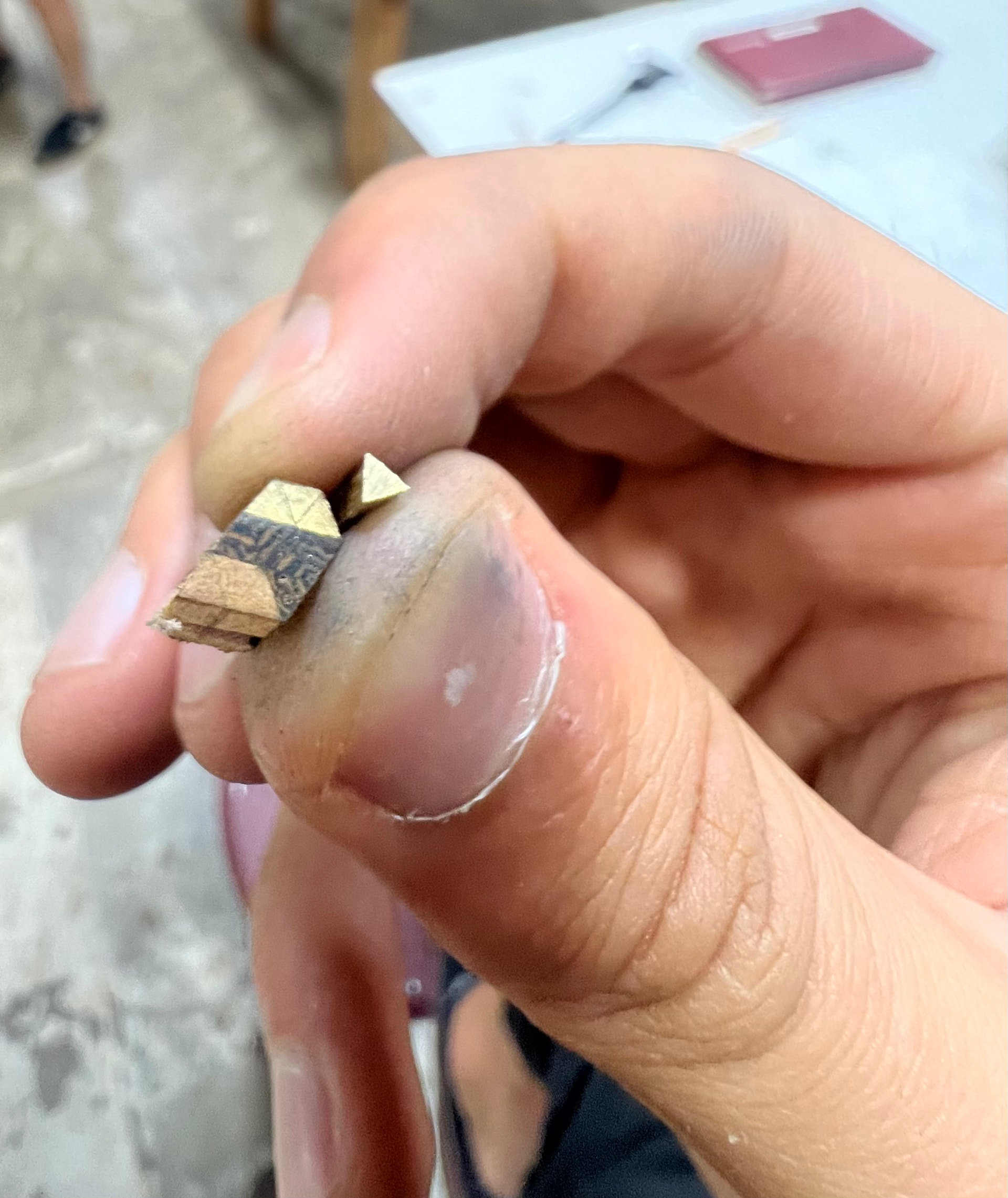
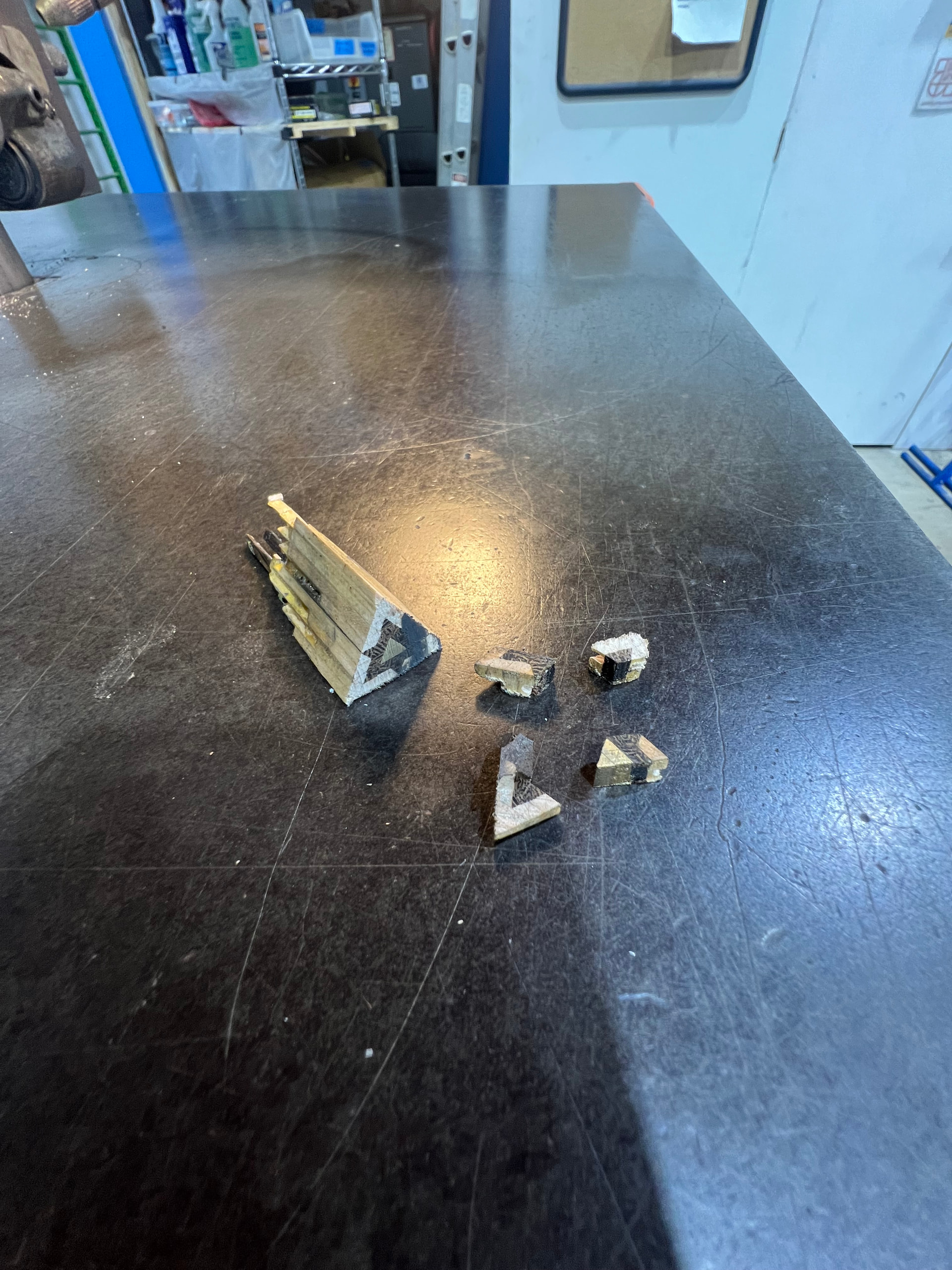
Hi all, I am attempting to glue together pieces of wood and brass but am having limited success. I am using JB clear weld quickset 5 minute epoxy to glue the brass to brass, and wood to brass, and titebond II for wood to wood. The wood glue joints are all solid, it is just the epoxy that is turning brittle. I discovered this after attempting to cut thin veneers off of my assembled end grain block. Any help/ suggestions on adhesives? Ideally I would want to use the same adhesive for wood to wood, wood to brass, brass to brass to simplify the glue up process.
I attached a link below for the epoxy I am using, and also a resource others have recommended for multi medium glue ups.
Hey Gem, I used our finest wood bandsaw to cut through the wood portions, and then the do-all metal vertical bandsaw to finish the brass inside, and remainder of the cut. I could probably do the entire thing on the do-all.
I see people use epoxy for wood glue ups, usually when more time is desired than titebond can provide. Although, I think the joint might be more visible with epoxy than using titebond.
It’s hard to tell what is going on from the photos. Did you sand the brass before applying glue/epoxy?
Try “oily glue”. It’s a Chinese term, it’s not actually oil. It’s a tough, flexible, clear adhesive with many applications on a wide range of surfaces. Not well understood but often surprises me.
Yea my fear is the visibility of the glue line if I use epoxy. To orient you what we’re looking at is basically an end grain pattern- I cut small pieces of wood and brass with triangular end grain cross sections.
I’m going to test it out epoxy for the wood to wood joints but the larger problem is preventing the joints with brass from failing. Maybe I can experiment with putting heavy scratches in the brass and wood to improve the bond?
The brass was sanded at about 100 grit, but that seems to not be enough. I can experiment with deeper scratches, perhaps 2-3 deep scratches groove on each piece.
Hey Joe, I’ve actually tried a fine hacksaw on a previous version, but I don’t think that’s the issue. Even if I’m able to cut a veneer off, the glue joint is so fragile it will usually snap off with minimal force.
Gluing metal to metal is always tricky. I’ve done it with Duco Cement, but it’s not a super strong connection.
My main thought is that a single glue is probably not your best option. Wood glue is always going to be much better for properly prepared wood surfaces than anything else.
Thanks for the tip! Definitely planning to stick with wood to wood joints, but looking for an alternative for the joints involving metal. One idea I’ve entertained is solder the brass pieces to each other, but that still leaves the question of how to glue the wood to metal.
Zak, something to consider if put deep scratches on the brass: the scratches might show up on the end when you cross cut it. Because the brass triangular pieces are so small, they would most likely be too small to notice, however I wanted to bring it up as something to think about.
Very nice design. The problem you have is brass expands and contracts at a much different rate of wood. Brass also conducts heat rather well so when cutting, whatever you use (other than water jet) friction creates heat at that may be enough to break the bond when cross cutting thin veneers. To achieve a better bond start with preparing the brass 80-120 grit scuffing (same technique used for adhesion of barrel to substrate in making pens). After that, clean with acetone, denatured alcohol (also labeled as fuel), and or isopropyl alcohol (over 90%). Device a way you can clamp, it has to be clamped quick and good. Has to be quick because with the adhesive available for the most part they do not have a very long open time they will set quick so you may not have time to put the pieces together. So you may want to do the center part first and build out. Adhesives: two part epoxy transparent or you can dye it gold. You’re constrained to whatever open time it gives you and could be messy. Once you finish the blank and get a flat side, use thin superglue to coat the surface to strengthen and try cutting the veneer. A second technique would be gluing the flat end to a piece of MDF or other material, apply masquing tape on one side and super glue on your stock, cut veneer and carefully separate. Another adhesive would be polyurethane glue, follow the instructions (they differ between brands). Again, it does not give you alot if time, is messy as it foams as it contacts the moisture in the air. Once all is glued same procedure to cut. An MMA glue is a good option but they are expensive but they have different setting times. Regardless of the adhesive, wipe the brass clean with whatever solvent you use right before you glue it.
But if I had to do it myself, I woul leave the space for the triangle brass piece open, glue all the other pieces, cut the veneer and then insert the brass piece and use the same adhesive to keep it in place. It would help the final use/purpose as you could assemble thin pieces following the japanese kumiko technique. Maybe now that you have an insight into different options you can come up with a technique of your own. Again very nice design, I am not monitoring this chat just signed in to kinda dig you out since I liked the creativity. Keep making dust!
Hey Jose thanks for this write up, it’s very informative! I’m not sure I followed the two veneer cutting process you outlined, but think for my current problem it’s slightly besides the point.
As for the suggestion for what you would do, that won’t work because I will be carving the face of the pattern after assembling it into a larger tesselation. To help you visualize this orientation, imagine if you made a cutting board with wave pattern on the surface. This isn’t for a cutting board, but it might help communicate the challenge I have.
I actually have no need for cutting veneers, but by doing so I exposed very weak joints on the brass to brass and brass to wood bonds. That being said, I think that problem is still outstanding. To compound on this, it would be nice to have a longer set time so I can fully assembly this pattern before glue up. Currently, I am using PVA for W-W and Epoxy for B-B and B-W (brass, wood).
If you don’t need to cut thin veneers, I think larger slices would be less prone to failure, as there will be more glue surface area and less flexure. Other tips about surface prep are good: scuff with 60 grit and clean well with a solvent. I’d say epoxy is the right choice, but you might try CA (super) glue for the brass to wood connection.
I also second the recommendation to use a hacksaw or fret saw instead of the bandsaw. It will impart less tool pressure on the joints, and will be much sharper than the DoAll.
Well, first you are trying a technique that is not common or many people would not think about, so you need to think outside of the box. Often as people evolve in making things, they tend to think complicated things require complicated solutions while in reality most everything goes back to basics. So, in a way you are wrong in cutting a thin veneer and assuming you have weak bonds. Under normal circumstances even if you had an all wood piece, cutting a veener at the end of the blank there is a high probability that the pieces would break under little stress. That part of the blank is prone to be weak as most people do not clamp the ends (I do not know how you clamped yours). Myself I usually discard that piece and the last or keep it as an example out right i assume they are weaker. As Evan suggested try cutting what youre going to use and go from there. A good example would be if you crosscut a 1/8” piece of a board, it would break rather easy either while is being cut under the stress of the blade or there after if you twist it a little. You would be wrong to assume you have a weak board when you actually need 2” pieces because you would have a hard time breaking a 2” piece. Have you tried cutting a second piece? And if so, was it the same result?
Im having a hard time seeing your vision or ultimate use. I assume the piece is going to be an inlay, intrusion, or sandwiched layer. If so, as Evan suggested, you are going to gain strength from the bonds around the brass and also the bigger the bonding area the probability increases in surviving the stress or trauma of mechanical tools. Another thing you can consider is once you have your board (I assume is going to be flat), you coul use a backing board such as MDF or similar material, glue your stock to it, to give you more holding strength while carving your stock. Then remove the MDF. You could use one or multiple layers of wood veneer (they’re about 1/16” thick) as you backing board. The veneer’s strength coupled with the adhesive you use would give a higher strength and depending on the species you use, it could give an attractive backside if is going to be visible. A far out alternative would be to get the pieces cut with a water jet then incorporate into your project.
As far as adhesive open times. PVA glues Titebond 3 has the highest at 15 mins. You could add a little water (like 5%) to give you a little more time. They do have what is called veneer glue, this one has around 25 mins. When applying it if it looks wet youre still good. If it looks dull, you can reactivate by applying another coat or a quick pass with a wet rag. There are too many variants in the epoxy depending on the brand so you have to find one thats has the open time you need. MMA530 I think gives you 25 minutes of open time.
I wil not be back in TX until first week in September. I do plan in being in Assembly but it would be early in the morning as what I’m planning in doing, requires a set up and use of a machine for about an hour and I don’t like highjacking a machine for that long while there are other people waiting to use it. I’ll be open to meet you in the afternoon/evening.
Thanks for your in depth responses Jose! I will go over all your suggestions and report back. I will likely still be tinkering with this in September, so if you’re ever around, I’ll give you a holler.