Airstrike HVAC and the Woodshop HVACs

Airstrike HVAC (Veteran and Woman owned business) has been helping us with our quarterly HVAC inspections this year. They’re also about to help us in a large way by upgrading the units in woodshop with a significant amount of donated project materials!

The end result will look like an extended HVAC return with two stages of filters. The 20x25x4” boxes will stay on the units where they currently sit. The extension will run down along the wall to a 1” thick filter and be about 7’ to 8’ off the ground. The 1” filters will be something easily changeable, and will prolong the life of the heavier duty 4” filters in the main unit, requiring checks and changes much less frequently. We expect to have to change the 1” filters weekly.

Ask #1.
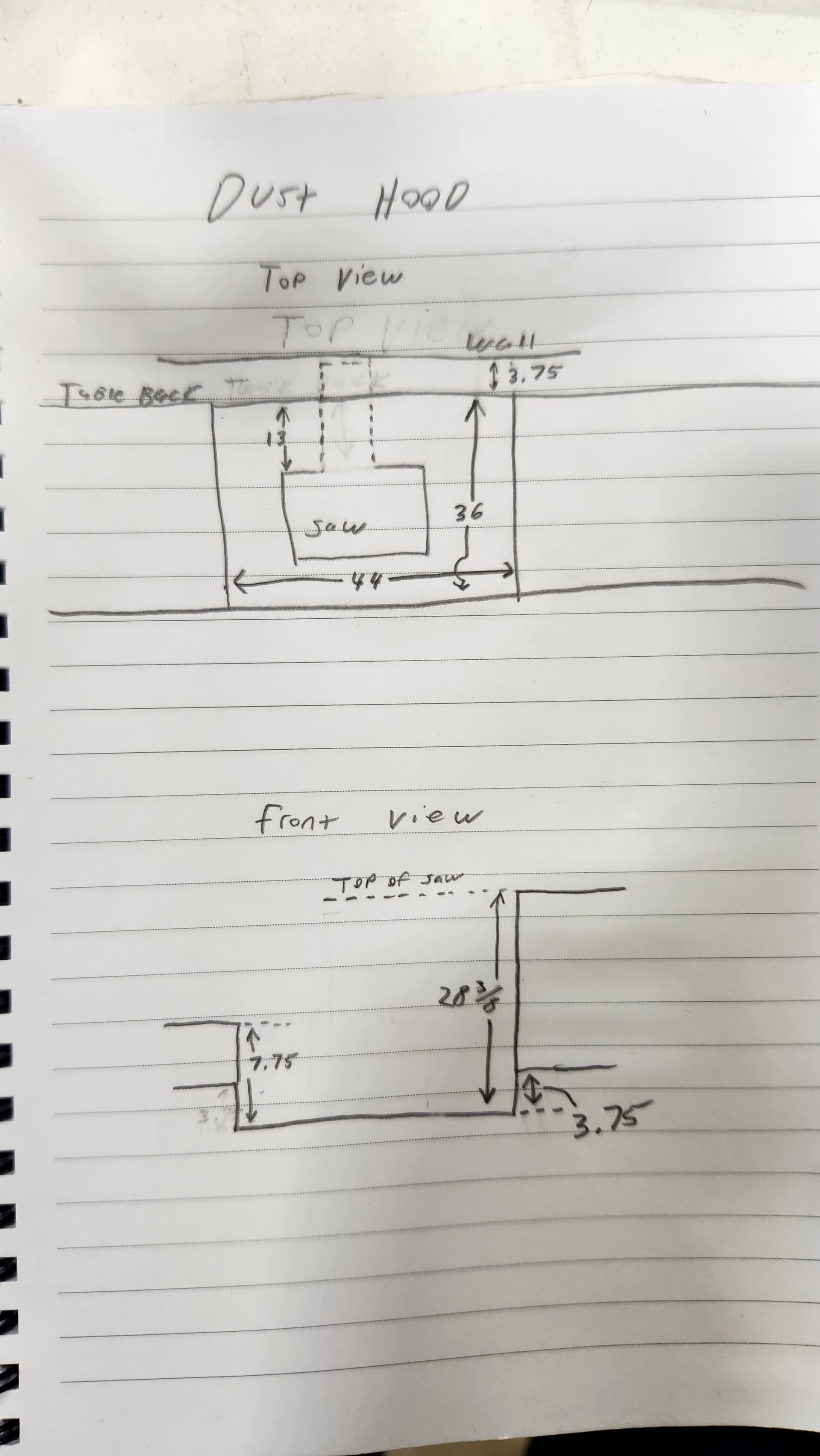
Given the placement of the drops, HVAC 2 will drop down right above where the miter saw is. In an effort to help prevent dust from blasting directly into the filter, I’d like to get a basic dust hood covering it. Can someone help us get this going in the next 1-3 weeks? Even if it is a few basic pieces of plywood screwed together, anything to help deflect dust down instead of up would be great.

Ask #2
I’d like to do something for Airstrike as a thank you to their technicians and company for helping us out this year. If anyone has some suggestions or means to assist putting a “thank you” together, please let me know! A pen, a plaque on a funky piece of wood, or maybe a peice of metal embedded in a clay body lasered with leather strapping embedded in a circuit board with saw dust 3d printed on it.

To sum it all up, our HVACs should be in much better shape going forward and should help make next summer much easier to maintain.

Robert

7 Likes

If you want to make them a cutting board with their logo imbedded into it, with one of the CIC cutting board kits, I’d be happy to help with that.

2 Likes

That sounds like a great option!

I’d suggest that we go talk to them and ask if we can make something for them that would be useful in their business, for example, build them some shelves, some storage, a table for a power tool, that is, some project they’d use daily which would make their business better. Don’t get me wrong, Frank’s suggestion is great and nice. But, I’d dunno, maybe I’m more of a practical person, and would hope we could do something for them after what they’ve done for us.

6 Likes

Some quick measurements if anyone want to take a crack at the design.

1 Like

I understand the top view, but I’m puzzled by the front view. Can you sketch a simple 3D representation too

@Kellan_di_Donato tagging you for this since I know you were interested in helping on the dust hood as well.

Thank you Austin!

“The end result will look like an extended HVAC return with two stages of filters. The 20x25x4” boxes will stay on the units where they currently sit. The extension will run down along the wall to a 1” thick filter and be about 7’ to 8’ off the ground. The 1” filters w

ill be something easily changeable, and will prolong the life of the heavier duty 4” filters in the main unit, requiring checks and changes much less frequently. We expect to have to change the 1” filters weekly.

Wait, what?

1” filters in front of a 4”? Pleated paper? How many?

“Staging” filters rarely makes sense.

Static pressure needs to stay under 0.5in WC. Less is always better. At 0.9, you’re looking at system failure. Between, you get poor cooling and high energy costs.

4” 20x25 pleated paper on a 5 ton is about 0.30 to 0.38 in. w.c. when new. It doesn’t take long to load up past 0.5wc. This is already undersized (too much flow resistance) for 5 ton in a woodshop.

But adding pre-filters stacks more resistance and pressure drop. That’s the last thing you want to do.

If you fitted a LOT of 1” 20x25 filters in parallel and then in series with the 4”, and were very selective of where you’re getting the filter media from, the total static pressure could still work when it’s perfectly clean and you, but it doesn’t make much sense to configure like this.

The key problem is the 4” 20x25 filter cabinet, when fitted on a 5ton, is 576 fpm flow velocity. The filters are only rated (generally) for 500 fpm (some say 600) in general use, not a woodshop. That’s not right. Fix the problem you have, don’t put a new problem on top of it.

There will only be one 1-in filter added to make this a two-stage setup.

@dannym I appreciate your concern in this subject and wanting to make sure it is going to help things. I don’t appreciate how you are suggesting this is a completely botched plan without providing a better alternative. A professional HVAC company helped develop this plan. If you have the time and materials to develop a superior plan and donate resources to it I’m happy to work with you on it.

1 Like

@Kasper Thanks for the measurements! That will save me some time. I’m planning on building the hood this Monday. I’m pretty much just going to copy this video.

1 Like

I’m planning on being in on Monday afternoon, if you need a hand.

1 Like

To folks curious about helping with a thank you gift, I was approached in person with a plan that I think everyone will like! More details soon!

There will only be one 1-in filter added to make this a two-stage setup.

There has to be some misunderstanding here. Putting a 1” ~20x25 filter in front of the 4” 20x25 is not viable and will promptly cause failure of the HVAC unit. Absolutely do not do this.

The misunderstanding may be that the configuration isn’t actually 1 filter, and that’s not what we’re doing. Miscommunicated to you, or I’m misreading the description here somehow, sure. My first theory would be that they actually plan to remove the 4” and fan out to multiple 1” and that the description of the plan got scrambled up a bit.

I’m just going the statement I can back up for sure: do not put a 1” ~20x25 filter in front of the 4x 20x25. Imminent failure of the unit would be certain, swift, and potentially very expensive.

I will clarify with the hvac company and reach out when I have details.

1 Like

The plan is for a 25x50 filter plenum in series with the HVAC, keeping the regular 20x25 in place.

@dannym

OK ran numbers on this for quite a while.

2x 20x25x1 followed by a 20x25x4 pleated paper is still not going to work. The 20x25x4 is already incorrectly undersized and will exceed the max static pressure (choking the unit) at only about 25%-33% of that filter’s ASHRAE dust capacity. You have to change it way, way too soon because, due to being undersized, it has to pull that high 576 fpm load through it. Adding another stage without addressing that will make its issues worse, and it won’t be possible to configure it to be highly effective at actually addressing the PM2.5 problem. Depending on what filter you buy, it may be at its limit or past it the moment it’s turned on.

Key problem is that filter cabinet is undersized. It needs 2x 24x24x4 in a “A” configuration, any way you slice it. The first stage absolutely needs to be tackified polyester media, not pleated paper. 20 sq feet for 5 ton will be the minimum to hit the loading capacity profile. So 10 ft of 25” wide media.

Filters have a max dust loading capacity in grams of dust per sq in of area. Tackified polyester media is radically more capacity- 0.23g/sq in, pleated paper is 0.07-0.10g/sq in. Also, tackified polyester media does not show as much static pressure rise until nearing its max load.

But, that ultimate capacity is based on where it builds up 1” of static pressure, where the until will choke, when using standard face flow velocities. If you attempted a 2-stage with standard sizing rules, that would require 2” of static which is impossible. It could be under 1” of static while new, but it will be high enough that it will lose significant cooling capacity and efficiency, and fail with only moderate filter load. One incident of someone doing a lot of hand sanding without dust collection or a problem with the dust collection system can throw the equivalent of weeks of “normal” loading onto it in a short time, so it may not matter how often you waste money changing filters earlier.

The key is to design it with enough filter area on both stages that the total static drop is still within the unit’s static pressure limit when those filters are in their fully loaded states. This is also where the cost-effectiveness comes into play, as well as reliability. To do that, BOTH stages MUST be oversized by 80%-100%. That halves the pressure drop of each stage all any loading level, so the combined resistance is similar to one stage at standard sizing, and the filters can be used up to their load limits

And we really need to address PM2.5. PM2.5 is the actual health risk here, and you don’t get really meaningful capture unless the secondary is a MERV13. A MERV13 is out of the question if it’s only the 4x20x25 cabinet that’s up there now. That will have too much static drop with or without having another stage in front of it.

Now I’d looked at the options before, and rockwool duct board towards the wall looked mechanically problematic. Something has to hold that up, and those units are suspended and do swing a little bit. Rigid ductwork seems to have a high risk of tearing up if it reaches to the wall, or the wall is used to anchor it. And how to access the stage 2 filters, that’s a problem. Flex ducts would be of course not have that issue, but… well, it’d be super weird to use flex ducts like this.

All that goes away if both stages can sit on the unit. It actually can, and be changeable with a pole from the ground and maybe a lift pulley.

Back to the first part- I spent quite awhile going over these numbers. Putting 2x 20x25x1 in front of the 1x 20x25x4 is worse on cost, reliability, and overall HVAC efficiency

Putting this all together, yes I see how to “win” this. I’m drawing up the CAD and BOM now. This will keep the HVAC in the high efficiency range under the whole range of filter loading, get high single-pass clearance of PM2.5, could be changed without clearing the footprint for a large ladder, maximize cost-effectiveness, and should be able to go over 6 months between filter changes (hard to account for, but it’s able to reach 100% filter capacity utilization now (3x-4x better than we have now), increases the filter capacity by 2.3x, moves 60%-70% of the total dust mass to the prefilter, so, roughly, 23x the capacity of the current config before reaching max static drop. Yep, a 1yr change schedule under our existing shop conditions is indeed possible. $208 consumables per unit at that point. That’s substantially less operating cost than we have now. MERV13 filters that are much more effective at capturing PM2.5 cost about 3x more for the same area, but that’s after factoring that in.

But perhaps more important is that is after switching to MERV13, now has about twice the capture efficiency for PM2.5. PM2.5 is the long-term health risk (it takes months for the lungs to clear particles in this range) so that’s a big deal.

I need to know the exact XY dimensions of the end of the units. Also, what’s the total air volume in the shop? Length x width x height?
Even further past that, I would strongly recommend (and it’s super easy) to add static pressure metering. They can be built out of an ESP32 for like $20. Then you have no guesswork, you’re not wasting money changing filters before it’s needed. And, given the high cost-effectiveness, PM2.5 clearance, and long service intervals, they should be left on in “fan” mode (fan staying on while the compressor cycles off) when the shop is in use.

If you’re already sticking an ESP32 up there, you could also add a temp sensor on the outflow ($2 DS18B20 waterproof probe) and a pan flooding sensor. Then you have a lot of insight into which unit has a problem and what that problem is when the shop’s cooling is weak. Actually, spend another $2 for another temp probe taped to the coolant return from the outdoor unit. Then you can pretty conclusively diagnose busted condenser fan vs compressor or low refrigerant. The next level would be adding the actual refrigerant pressure sensors into the high and low side- but, installing those would require an HVAC company to empty the system and put in fresh refrigerant. That one’s far too much cost to justify unless they’re drawing it down and refilling for other reasons.

Actually, you’d just become the thermostat and IoT network the cooling control. That’s wildly better because you can sync and do load-leveling. That has important benefits on every front. Like under light demand, right now they might all kick on together and short-cycle, then repeat, which is bad overall. Excessive restarts lower the life of the compressor and condenser fan.

With them networked, it can shift fan-on preference to the units which have the least filter loading to sync the filters so they all reach the change point at the same time. It would be able to look at the room temps and only turn on the number of units needed. In the winter, it could avoid cycling on 4x 10KW heater strips at the same time and save $$ on peak demand charges. Occupancy sensors, and you get to set the policy for rolling back heating/cooling during the off hours and preconditioning before opening.

And it can self-report issues straight to Slack.

This would probably just make the Blue Ox filters obsolete. The HVAC has got much more capacity at a much cheaper cost. I’ll calculate if there’s any need for more clearance of really fine particles, but I doubt if there’s a case there. The HVAC filters would have 60%-80% first-pass removal of the whole PM2.5 spectrum and wildly outgun the CFMs of the Ox. That’s where I need the shop’s total air volume, needed to get the air change rate to see if there’s any need to have more fine particle removal. Probably not, but if you did need more, this system is so high performance and low cost it would make much more sense to get a used air handler off craigslist, strip it down to just a housing and fan, and add another filter to it.