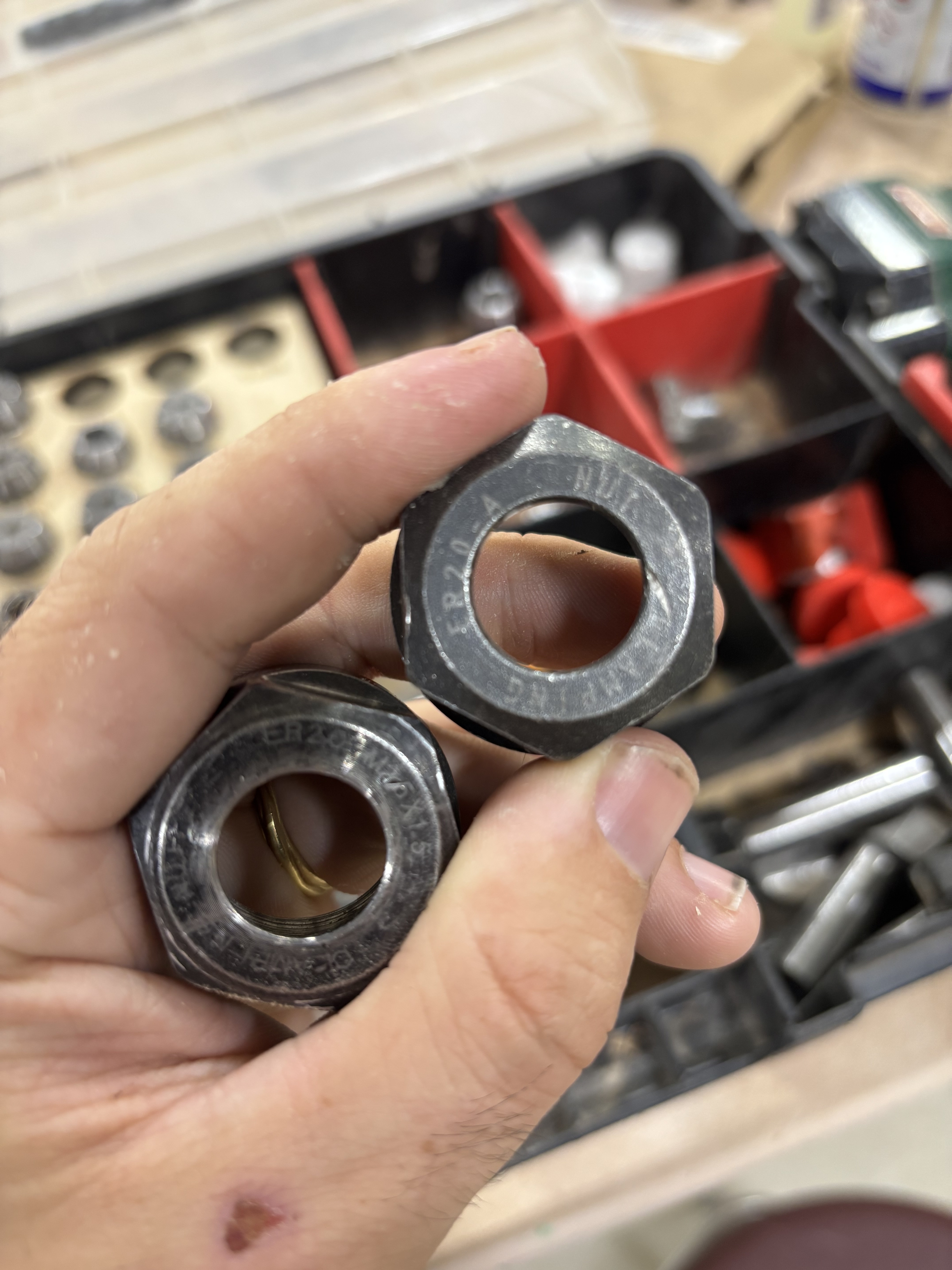
ER20 is the collet size standard. That’s all that is guaranteed to mate up. It doesn’t nail down the spindle thread or outer nut geometry
The intended standard is the suffix denotes the exterior wrench type, but silent on what thread it is internally.
ER20-A is the familiar hex nut, and conventionally M25x1.5 but M24x1 is possible
These all take their own special wrenches:
ER20-UM the round slotted nut and supposed to be M25x1.5 too.
ER20-M is the mini nut and ER20-MS is the mini slotted nut. These are supposed to be M24x1. Note the “M” means “mini”=M24x1 in the case of -M and -MS, but “-UM” is not “mini”, the -UM is always M25x1.5. The M in “-UM” is derived from the German Mutter (nut).
“ER20” with no suffix is just insufficiently labeled, not a different type. I’ve only seen it appear on full size hex, M25x1.5 thread, so those should be labeled “ER20-A”
Most ER20 spindles are M25×1.5 thread, but some use M24x1. That thread has to match. I think the initial REGO-FIX standard was supposed to be ER20 always means M25×1.5 spindle thread, then later the smaller “mini” ER20-M/ER20-MS variants were added which are always a M24x1 spec. But apparently not every vendor got that memo and made ER20-A M24x1 hybrids. Externally, the 20mm hex wrench the ER20-A uses, not a “mini” exterior, but mini M24x1 threads inside. No labeling convention for these. I’m going to be unkind and say “noncompliant abominations”.
You’d think an ER20-A in M24x1 should be labeled “ER20-AM”, but no such labeling standard exists. It SHOULD read “ER20A-M24x1” but not always. “Clamping” is sometimes on the labeling, it has no specific meaning. You’d think something that critical should be clearly designated with a suffix so you don’t pick up the wrong one. Wrenching the M25x1.5 nut on an M24x1 spindle thread could damage the spindle.
What you might want to look into is a bearing nut. The ER collet always presses into the spindle taper first and stops turning vs the spindle, the nut then tightens down by turning across the front 30 deg chamfer of the collet to press it in. That’s a lot of friction when tightening and it doesn’t make it hold better. Bearing collets have an axial thrust bearing where it presses on the collet chamfer, so it’s much less friction to tighten down. The bearing races only have relative motion while tightening, they don’t move against one another when the spindle runs.
For ER20 bearing nuts, I see a hex type “ER20B-A”, hex type “ER20GM”, one with slots on bottom also “ER20GM”- well, that already breaks the system where suffix indicates wrench style), and one with mid-slots (hooked “C” wrench) “CN20-B” which is still ER20 system.
Some ER25 bearing nut searching got me “OZ25”, that’s the OZ collet system which is incompatible with REGO-FIX’s ERxx collet systems.
https://www.amazon.com/CanCNC-ER20-Bearing-Collet-Chuck/dp/B0GJ6QQPQT/ref=sr_1_1?crid=2839G9ZB9DA6X&dib=eyJ2IjoiMSJ9.KH8kkk9vM-gJGwxx6B2JEVYPDopY5KlsKESS16T-pMOaVQY_6HNeMD6zRfC1_Y36G2pW8KebV1wUzR52pHIOV4hCECVXJHsxVXf1i2ROqKOLD_s4dBpNGBa0yHqAOyycaLp6Mha41eqIRIKn8BTaXVRNDm9Y2RiC6Q8xULIWOZ8JpHW89eteRK4y9y4e0lSfFWfHoO-lCF5lxDrwaTXSt4nYvfG8MZzbBj7vvi79uqimqwI-HxchtlTH_eWqqkX5g3Vk_9x50l49gi-dRlMxb4FW5VllFfP_a0HAoIHYwQ8.lR4JuRqyUoYbp2ntTQhvNItvw5ppSZKJzf94h_p099c&dib_tag=se&keywords=er20b%2Bbearing%2Bnut&qid=1791061818&s=hi&sprefix=er20b%2Bbearing%2Bnut%2Ctools%2C175&sr=1-1&th=1