Saw this and was curious what our laser pros think? I’m wondering what type of fabric you need that will prevent from burning through. I have a bunch of denim I’d love to test this with!
@Jordanva2 did quite a bit of lasering in denim, perhaps she’ll have some advice.
1 Like
I’ve seen a few folks engrave texture into textiles to good effect (for some reason Instagram won’t open the video you linked). I’d wager @Felipeg101 would be another good person to talk to if you can!
I’m rather baffled as to what that video shows. It’s got to be a galvo laser, but this would be a larger focal length than I’ve ever seen in an F-theta lens. Ah, no, there’s something different here- they probably collimated the beam before the XY galvo mirrors and there’s no F-theta lens at all. Maybe, I could see several ways that might get to this effect. The galvo head has to be several meters up. This is a really exotic setup. I’m fascinated, but it would be very difficult to justify developing and supporting a very special-use setup like this for a community shop.
Can you mark like this with something we have? Sure. It takes a fine touch, and depends on the dye and fiber type.
Keep in mind what fabric is- woven fibers running back and forth front to back.
If you burn through the fibers on top, then it’s no longer a continuous fiber, and then it immediately pulls apart entirely.
So, the goal is to be able to bleach out the dye (which is imbued into the fiber’s full thickness) and not damage the fiber.
Regular cutting doesn’t create a usable sweet spot for that. The best solution I found was to take it out of focus. Start by focusing with the tool, then look at the panel and see what the Z number is. It’s not zeroed so its absolute number isn’t important and can change from day to day. But it’s a reference. Drop the Z further and note how much it’s changed, e.g. it reads “z=2693.5mm” and you want to make it 10mm out of focus, jog down until it reads about “z=2703”. There is no room to move upward, that would make the air assist cone crash into the work before you get any practical effect. You’re moving down only, increasing the distance from the head. So if 10mm out of focus works, you have to record that somewhere as part of the settings. And the next time the work is thicker or its zero point shifted (again, never gets homed to an absolute value) it may read “z=2688.2” after focusing, so you jog to about Z=2698 to get the same 10mm out of focus.
This makes the beam spread over a wider swath. It’s useless for cutting, but better for very specific marking situations. With the wider swath, you use a much wider line interval, which makes it go really fast too.
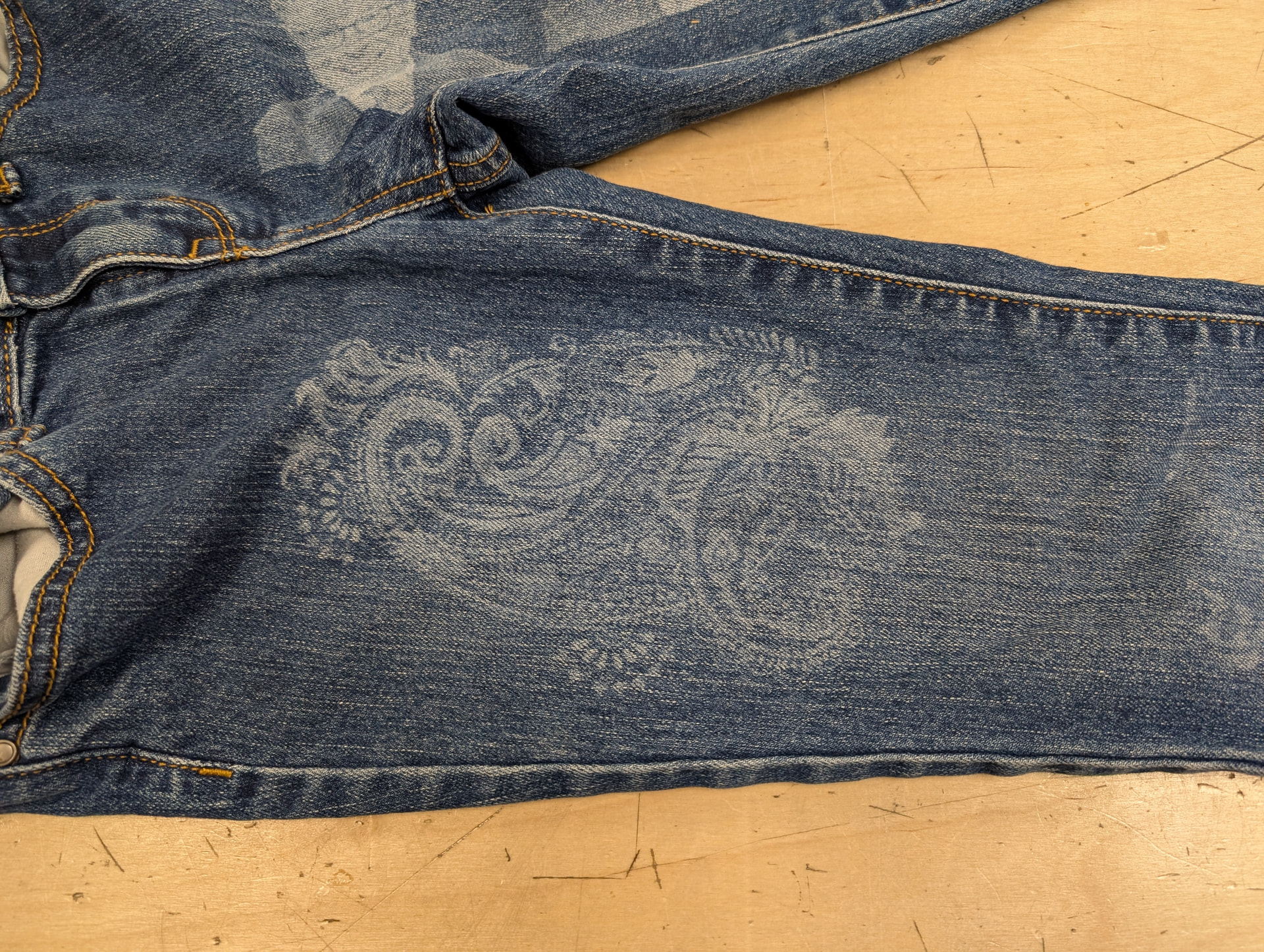
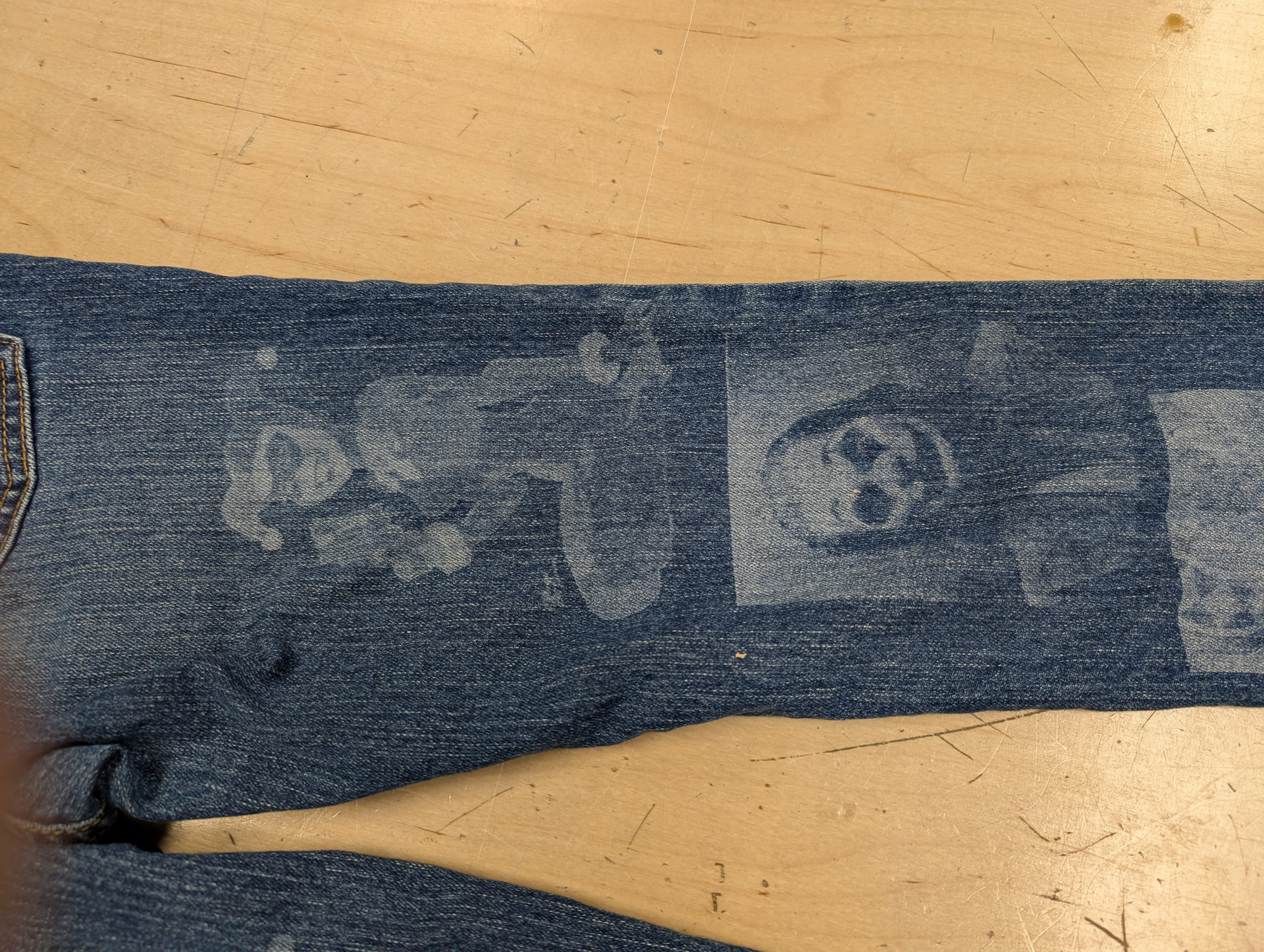
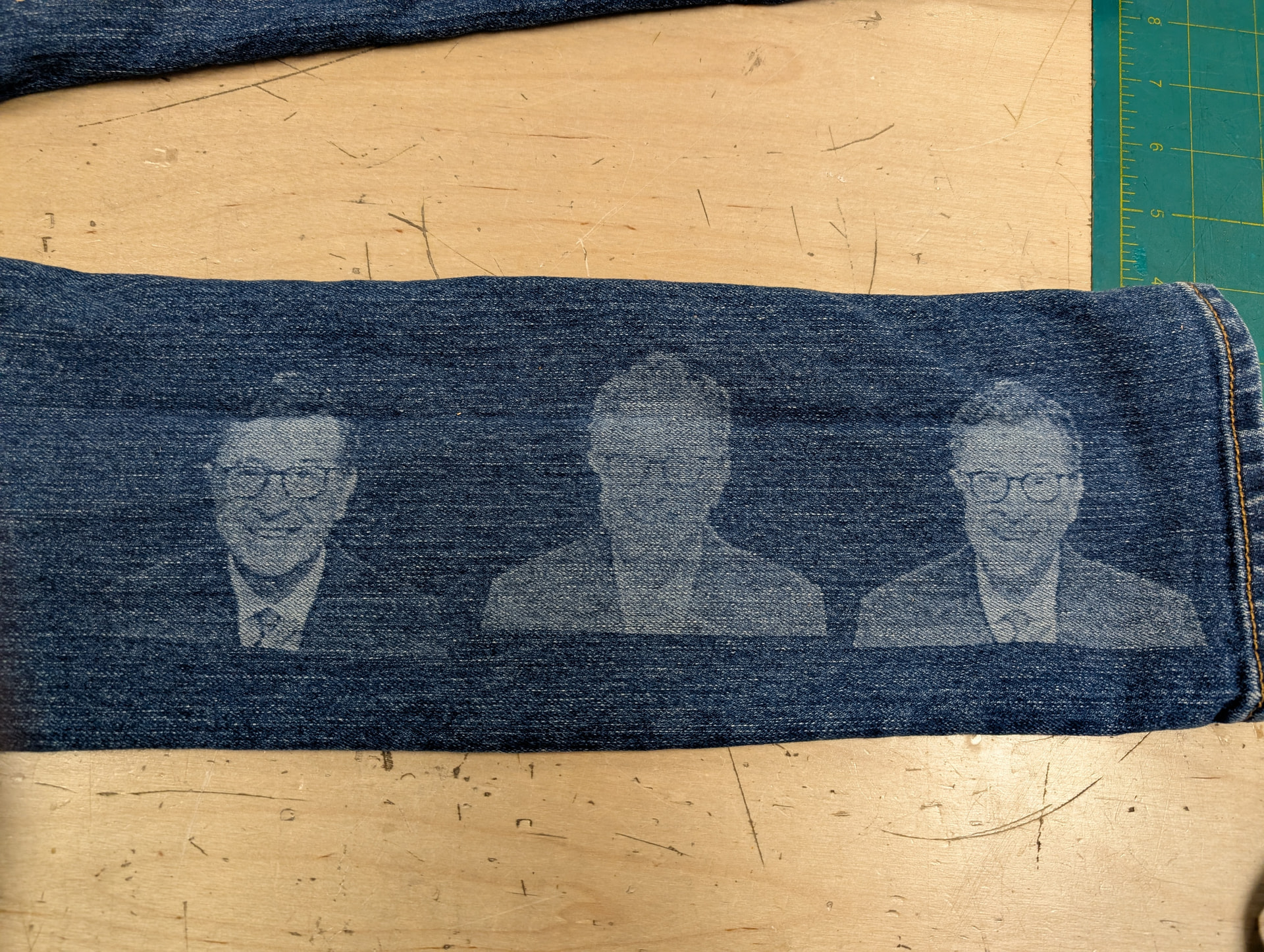
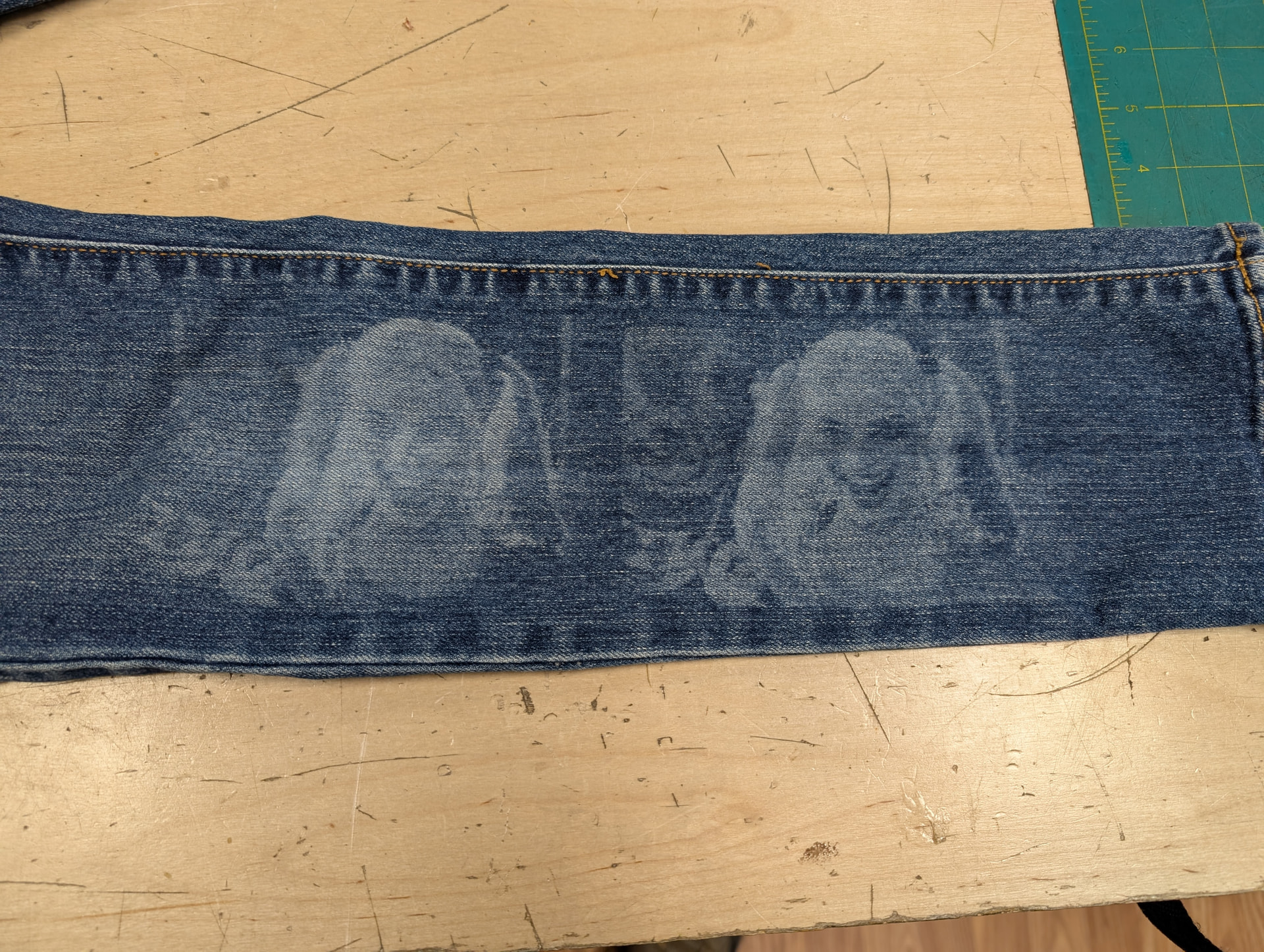
I was able to do blue jeans, actually the stretch jeans which I thought would be the least suitable since the elastic content would be really temp sensitive. Yet it seemed to work great and survived washing just fine. Inverted image since “burning” bleaches it lighter, not darker.
It’s tricky to tune, and really wouldn’t work with Dorian’s HVDC excited CO2 laser source. That laser type has many fundamental issues that make fine-tuning difficult or impossible. Use Tarkin which has a high performance RF-CO2 source.
I examined under a microscope and it was pretty interesting. You see the strands on the surface loop back into it, but they’re not a solid thing like 3D printing filament. It’s a fibrous thread with air space inside and a loose, hairy surface. You’d think the fine hairs around the thread would at least be singed off first, but not really. Not with out of focus marking. It’s not a tight flash of energy that makes a high temp on the most exposed surface. The area never reaches the temp which damages the base fiber, but will break down the dye, and does so deeply into the fiber- the dye isn’t painted onto just the surface, it’s imbued into the whole thickness. Pretty cool that this works.
3 Likes